Stock Picks
Bumps in the Road
Apple, the Magnificent 7 and The Prudent Speculator’s picks remind us that the road to returns is anything but smooth.
We’ve discussed our current recommendation of Apple (we also owned it for 9 years during the 1990s, enjoying a more modest 222% gain) a few times recently, with the selection a new first-time pick in October 2000. It was hardly the juggernaut then it is today. Sure, it had a good balance sheet and reasonable valuation metrics (1x price-to-sales), but the company was losing money and then-CEO Steve Jobs was struggling to right the ship, with the now-ubiquitous iPhone still six-plus years from introduction. We made our initial recommendation and it promptly dropped 30% over the ensuing months.
A little more than a year later, the share price had risen, but things were still not well. We wrote in a Hotline: Apple CEO Steve Jobs commented, “Like others in our industry, we are experiencing a slowdown in sales this quarter. As a result, we’re going to miss our revenue projections by around 10%, resulting in slightly lower profits. We’ve got some amazing new products in development, so we’re excited about the year ahead. As one of the few companies currently making a profit in the PC business, we remain very optimistic about Apple’s prospects for long-term growth.” Our revised buy limit for AAPL is $16.56 as the company trades for just one times sales while maintaining a pristine balance sheet containing little debt and cash and short-term investments of some $12 per share.
From a marketing perspective, it’d be wonderful to tout that Apple was our “top pick” of 2000 and that we have held it ever since. After all, the latter is true and it is up 78,000% including dividends. But the reality is that there was no way for us to know that Apple was going to be a star, thereby deserving any preference, while the E.W. Blanch shares we bought around the same time would lose 28% before that reinsurance company was bought out six months later.
THE MAGNIFICENT 7
Apple is now one of the Magnificent 7 (Apple, Alphabet, Amazon, Meta Platforms, Microsoft, Nvidia and Tesla) that have become the dominant forces in today’s equity landscape. Their sheer size drives a substantial share of the major equity market indexes and recent share price surges have created the idea that investments in these companies have resulted in easy gains. Of course, money flows often chase performance and performance attracts more money flows, creating a self-fulfilling cycle. Anyone without these stocks in their portfolios may feel as though they are watching the parade from the curb.
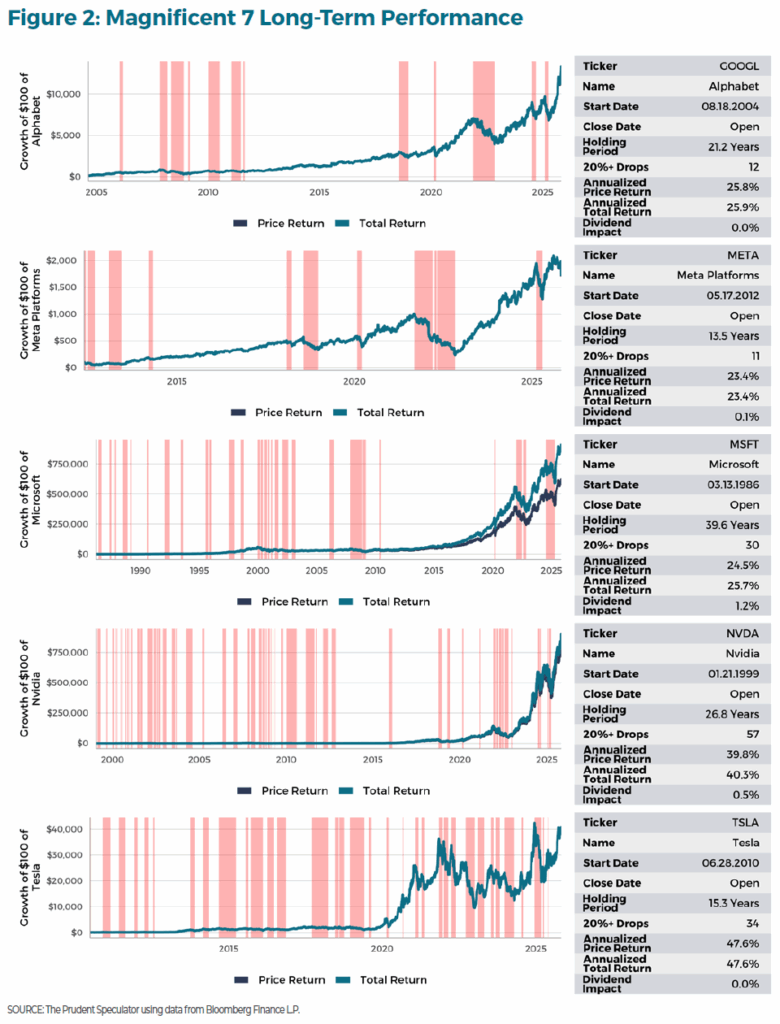
Recent returns justify some of that enthusiasm, yet the glow of multi-trillion-dollar market values tends to obscure how rough the ride has been. Use Apple as shown in Figure 1. Over its 40+ years as a public company, shareholders have endured 55 separate drawdowns greater than 20 percent. Fifty five! The long haul certainly delivered a superb 19.9% annualized return, but that required years of patience and enduring through some bruising selloffs.
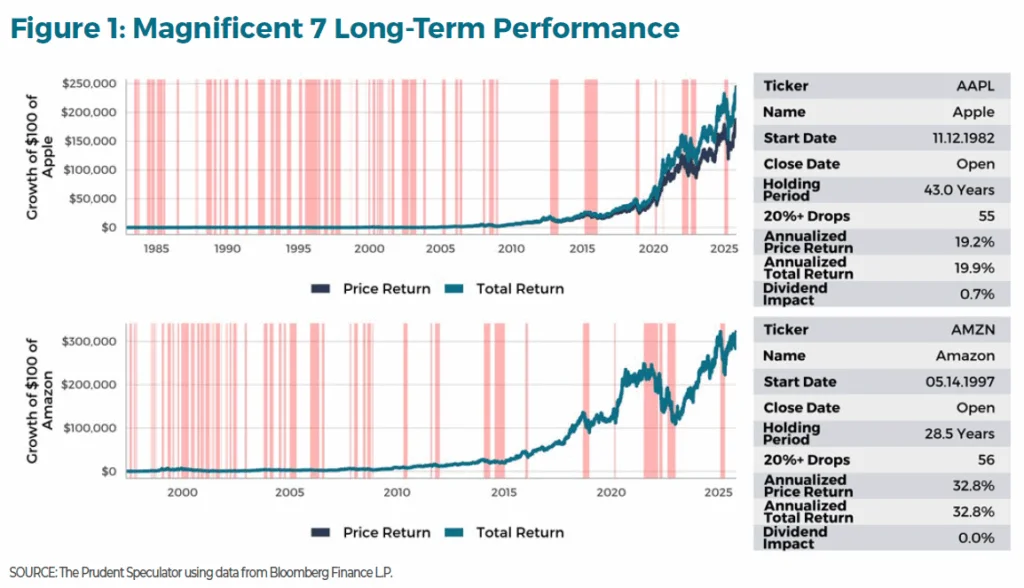
The pattern repeats across the group. Amazon, Nvidia and Tesla have averaged nearly two 20% pullbacks per year. Alphabet and Microsoft have offered somewhat gentler paths, but even their long-term charts are dotted with sharp downturns. Looking backward with today’s mighty gains already in pocket, it is tempting to believe that it was easy to hold firm through each market stumble. There are certainly success stories out there, but evidence from DALBAR, Morningstar and others shows that investors often retreat to the sidelines at exactly the wrong times. The Mag 7 may be headline-makers today, but their histories remind us that durable success rarely comes without discomfort.
DIVING INTO TPS STOCK PICKS
In our paper, Everything You Need to Know About Diversification, we reviewed academic work that supported owning more stocks over fewer. We paired that research with our own number-crunching. Using a decade of Russell 3000 index data and 100,000 simulated portfolios spanning five to 100 holdings, we showed that our long-standing target of 70 to 90 positions isn’t arbitrary. Diversification pays off in real portfolios and reinforces its importance in asset allocation decisions.
That exercise also prompted a deeper question. Our newsletter highlights individual stock opportunities every week in the Market Commentary and each month through ten Research Team highlights in the Portfolio Builder section. While working on that diversification study, we were prompted to review our own assumptions related to portfolio construction (i.e. portfolio weight decisions) or the benefit of owning a broad set of undervalued businesses (i.e. we have a good selection process).
We pulled every new stock recommendation from 2009 through 2024 and calculated total returns, including dividends, across a series of holding periods. Positions held only part of the window were counted in the horizons for which full data existed.
The early results were fairly humbling. In the first month, the average new pick barely moved. Over three months the average gain was 2%, although dispersion was wide. Big Lots led with a 60% jump while Paragon Offshore sank 60%. Patience is no small virtue, as it turns out.
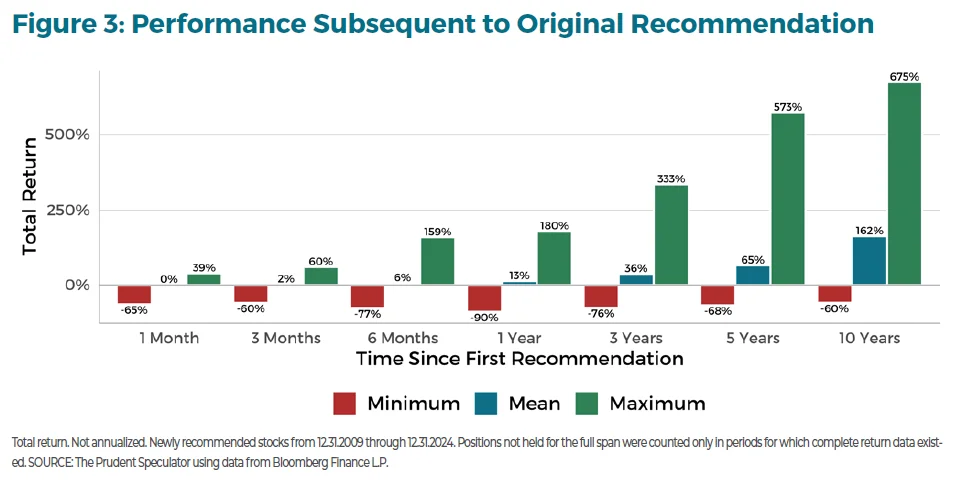
Time in the market trumps market timing, we say. And time improved the prognosis here, too. Return spreads widened as winners won and laggards struggled. Of the 37 names held for ten years, the average total return was a handsome 162% (10% annualized). Jabil Circuit was the largest gainer, soaring 675%, while Goodyear Tire’s 60% drop was the worst long-term loser.
Dividends also proved their worth. There were six stocks that showed negative price returns, but still delivered positive total returns once income was included. TotalEnergies is a textbook case, down 13 percent on price alone yet up 48 percent when dividends were factored in. Of course, an annualized return of 4% trails most broad indexes, but we suppose it does beat a poke in the eye with a sharp stick.
PULLBACKS
We spend a lot of time extolling the long-term performance track record for Value stocks, dividend payers and the equity market in general. In this paper, we wanted to do a deeper introspection by exploring the stocks that haven’t worked out (or more optimistically, haven’t had their time in the sun).
Figure 4 charts drawdowns by recommendation year. In 2015, we offered 20 new recommended stocks for investors to consider for their portfolios. As it worked out, Designer Brands was the clear laggard, at one point down as much as 91% from peak to trough. We eventually parted ways with our shares in mid-2020 at a 67% loss.
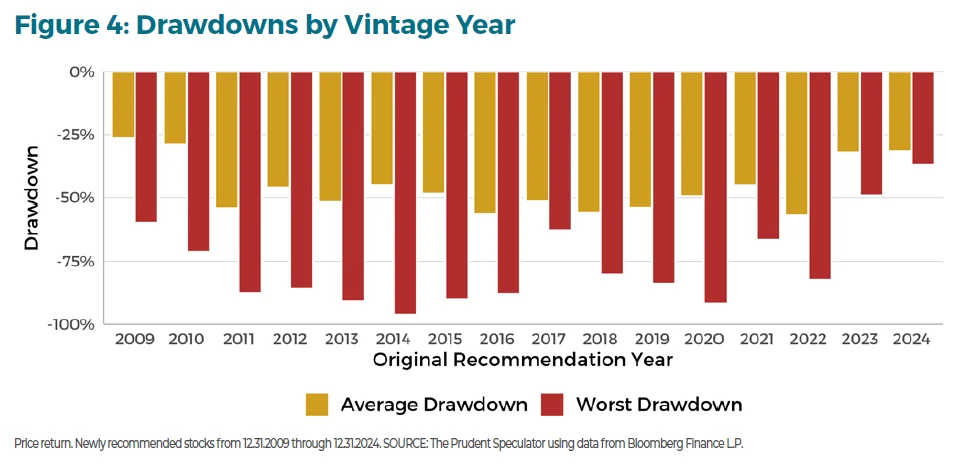
The full vintage fared much better, producing an average total return of 43 percent on an unannualized basis. Most positions of the group have since been closed out, but several remain in our portfolios today, including Fifth Third Bank, General Motors, Gilead, Cummins and Merck. That group has generated an average total return of 209 percent, underscoring why patience and a broad set of holdings remain central to the TPS playbook.
STOCK PICKS FOR THE LONG TERM
Before breaking out drawdowns by holding period, it’s useful to frame why duration matters so much in the equity selection process. Short windows often tell an incomplete story. Markets rarely move in straight lines and Value names in particular can take time to close the gap between price and worth. Early volatility, disappointing quarters or shifting macro winds can mask improving fundamentals, creating temporary pressures that look far worse in isolation than they do over a more meaningful stretch of time. A single downdraft can feel like a permanent condition when viewed over weeks or months instead of with a filter focused on years, the latter the time horizon of most investors.
The relationship between time and outcomes becomes even more important when analyzing the durability of a discipline. Great businesses typically compound value slowly and steadily, rewarding those who sit through the noise. Weaker firms often expose themselves in the same way: not through a single sharp decline but through a pattern of failing to recover. Measuring drawdowns across different holding horizons allows us to observe how often stocks rebound, how quickly setbacks heal and how reliably the winners offset the stragglers.
Lengthening the lens also helps separate temporary dislocations from true permanent impairments. A two-year setback can feel severe, yet many Value holdings have historically regained ground in the years that follow as sentiment improves, cash flows normalize and expectations reset. By contrast, stocks that remain underwater across five, ten or more years tend to reflect deeper structural problems. Studying each segment side by side shows how staying invested through full cycles, rather than reacting to early drawdowns, has historically been a key ingredient in the TPS approach.
DRAWDOWNS BY HOLDING PERIOD FOR STOCK PICKS
Looking at pullbacks through the lens of time adds a layer of insight that raw performance numbers cannot capture. Every stock will experience setbacks, but the depth and persistence of those declines shift meaningfully depending on how long the position is held. In Figure 5, the data across our four holding-period buckets shows that shorter-term ownership exposes investors to the full force of market noise, earnings surprises and sentiment swings. In the first two years, the average drawdown is steep and the worst cases are brutal. This is the period when fear tends to override fundamentals and when Value stocks often look most out of favor.
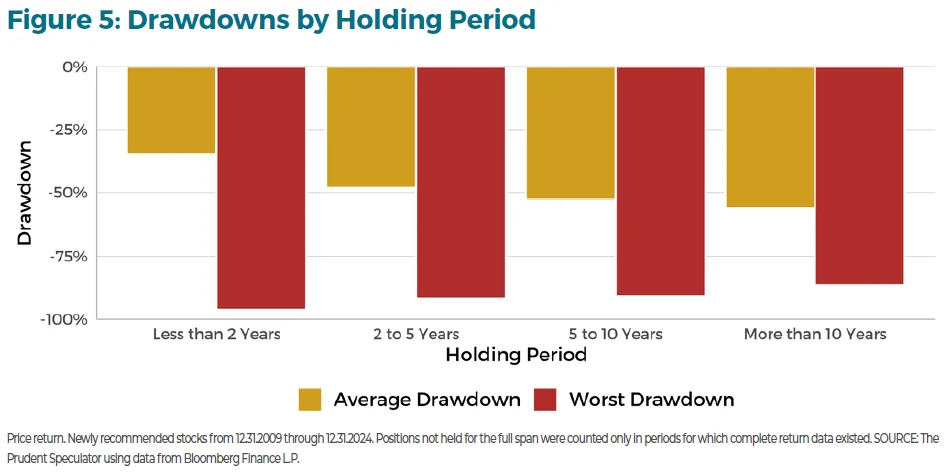
Extend the horizon to two-to-five years and the character of risk changes. Drawdowns remain meaningful, yet recoveries start to present themselves more consistently. Many companies that stumbled early in our holding period begin to regain their footing as the market sees the value in the companies. The worst outcomes usually still reflect real headwinds, but the distribution becomes healthier. For patient investors, this is often where the gap between the current price and our Target Price starts to close.
Holding periods of five to ten years further illustrate the benefit of time. Average drawdowns moderate as more companies experience full cycles of sentiment and operating performance. The worst cases remain significant, which is no surprise given that some of our theses just don’t pan out. Yet the broader pattern is one of upside. Drawdowns that once looked catastrophic often fade from memory and are replaced with feel-good healthy investment returns.
The longest bucket, ten years or more, underscores the core TPS lesson. Time has historically been the friend of disciplined Value investors. Drawdowns have happened during our holding period to nearly all of our stocks, many of them severe. Happily, our experience has been that the winners win more than the losers lose, and decades of dividends and business growth overwhelm the periods when prices retreat. A thorough review of drawdowns over time reinforces why patience, diversification and a broadly diversified portfolio of stocks remain cornerstones of our approach.
POSITIVE RETURNS
The chart on Figure 6 shows how the odds evolve as time passes. Each bar is split into the percentage of periods with positive total returns and the percentage with flat or negative results. In the short windows of 1, 3 and 6 months, gains and losses are not far apart. Day-to-day headlines, earnings surprises and shifting sentiment dominate, so the experience looks to be more like a coin toss.
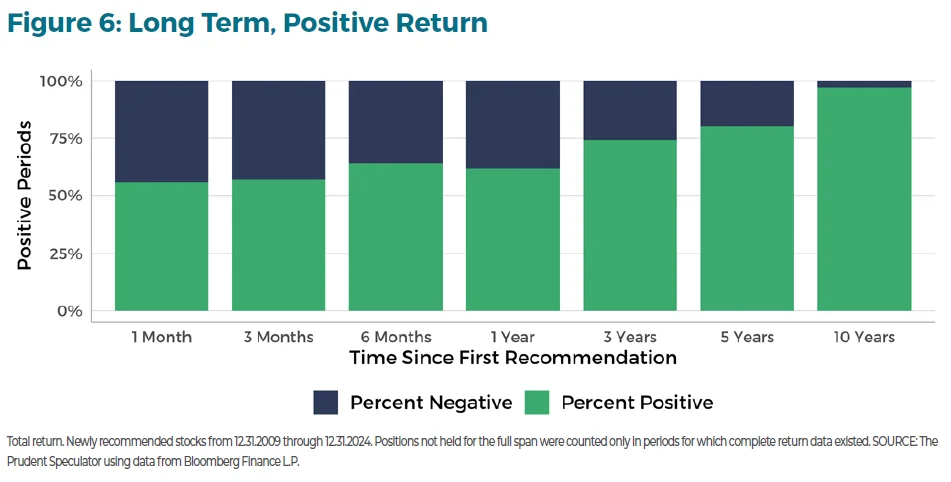
As the horizon lengthens to 1 year, 3 years, 5 years and ultimately 10 years, the green portion of each bar grows and the blue portion shrinks. The message is simple. The longer the holding period, the higher the likelihood that a recommendation delivers a positive outcome. That pattern aligns with decades of market history and reinforces a core TPS principle: give fundamentally sound, undervalued businesses enough time to work through their difficulties.
INDIVIDUAL RESULTS FOR STOCK PICKS
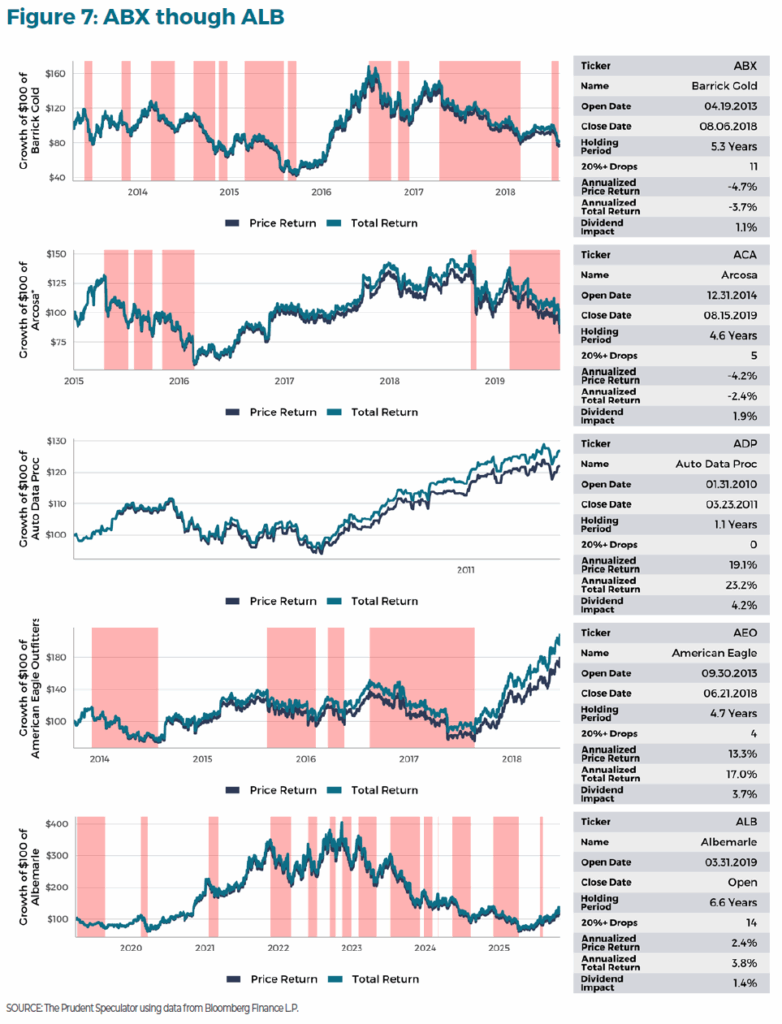
The pages that follow step away from the averages and look at the individual names behind the statistics. For each recommendation, we list forward returns across multiple time horizons so readers can see how the path unfolded for specific companies, including the dozens of individual 20% Bear Markets. Some stocks moved higher quickly, others slogged through extended drawdowns before recovering, and a few never fully bounced back.
These tables are meant to be studied, not skimmed. They highlight how uneven the journey can be, even within a successful discipline. Big winners more than offset a collection of modest losers, while dividends quietly pad total returns over time. Together with the probability chart, the individual stock outputs show why diversification across many holdings and a willingness to sit through uncomfortable periods have been central to the TPS approach since day one.
Editor’s Note: Please download the full pdf for all picks (the file size is large).
THE ROAD AHEAD
Certainly, we never want to simply rest on our laurels and we have long evaluated new valuations metrics and considered measures to improve our methodology. Of course, markets are constantly evolving and a factor that worked for the past decade is not guaranteed to be successful over the next 10 years, so we have to be careful not to kill the proverbial goose that has laid the golden eggs in favor of the bird du jour.
Still, given that momentum has long been an investment factor with favorable long-term performance characteristics, the charts below could lead us to become a bit quicker with our trigger fingers on stocks that have lagged for long periods of time. As Warren Buffet states, “If a business does well, the stock eventually follows,” but history shows that not all businesses do well.