
The Prudent Speculator Weekly Commentary is expertly curated every week as a valuable resource for stock market news, investing tips, business insights, and economic trends as it relates to value stock investing. In this week’s Market Commentary, we discuss A.I Trade, Value, Economics, Earnings and more Stock News. We also include a short preview of our specific stock picks for the week, the entire list is available only to our community of loyal subscribers.
Executive Summary
Webinar – Dividends & Diversification Link & 30 Undervalued Stocks
A.I. Trade – Nvidia Earnings & Management Comments; Still Liking the Al Frank Way of Selling a Little and Keeping a Little
Value – More Reasonably Priced Relative to the Historical Norm
Econ – Mixed Numbers; Fed Still Expected to Cut Rates
Sentiment – History Shows it has Paid to be Greedy When Others are Fearful
Patience – Volatility Always Part of the Process, but Upward Long-Term Trend
Earnings – Solid Growth Still the Forecast
Stock News – Updates on COF, MDT, LOW, WMT, TGT & KLIC
Webinar – Dividends & Diversification Link & 30 Undervalued Stocks
We want to thank all of those who attended our latest Webinar: Dividends & Diversification: Practical Strategies for Putting Capital to Work Across a Broadly Diversified Portfolio.
Here is a link to view the presentation…
Dividends & Diversification Webinar
…and here is the table of undervalued stock picks we offered, all of which had a dividend yield more than twice that of the S&P 500.
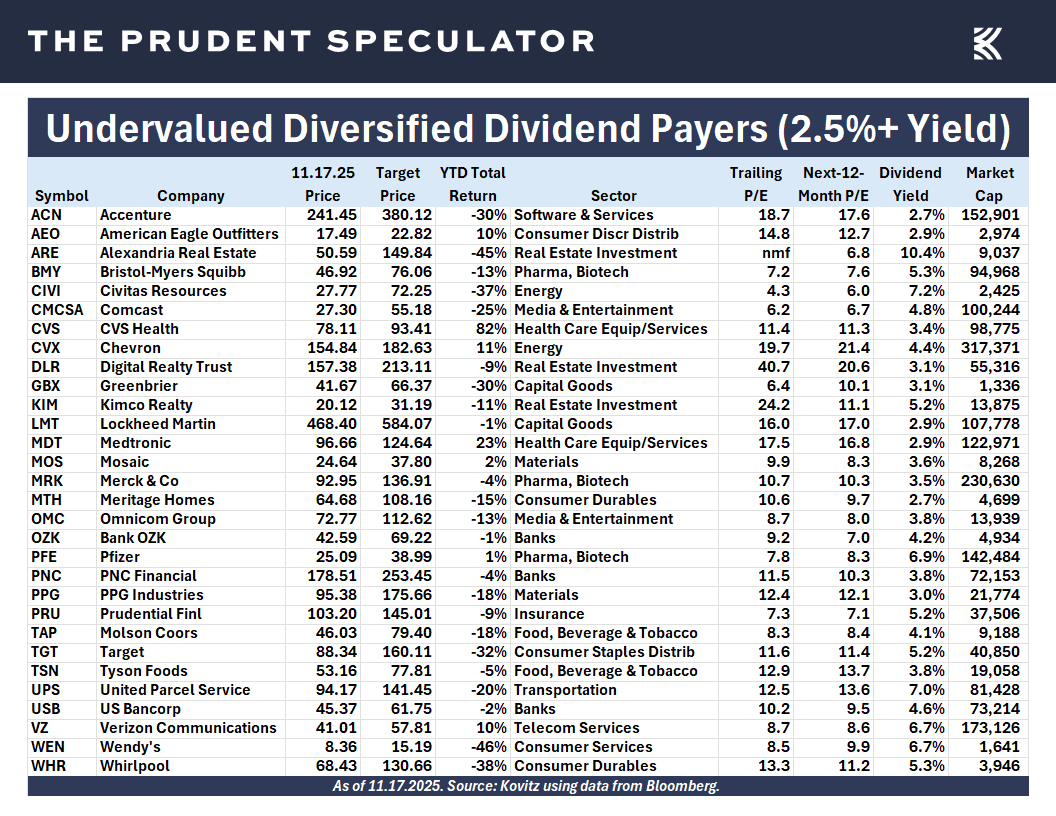
No doubt, readers will observe that the majority of the stocks on the Webinar list are down on the year…which is part of the reason they were highlighted. It has been a terrific year overall thus far on both an absolute and relative basis, so we could have featured our winning picks, but we always believe in full transparency, plus we assume that folks are looking to put new money to work, so we think they would appreciate a listing of names that have yet to have much, if any, time in the sun.
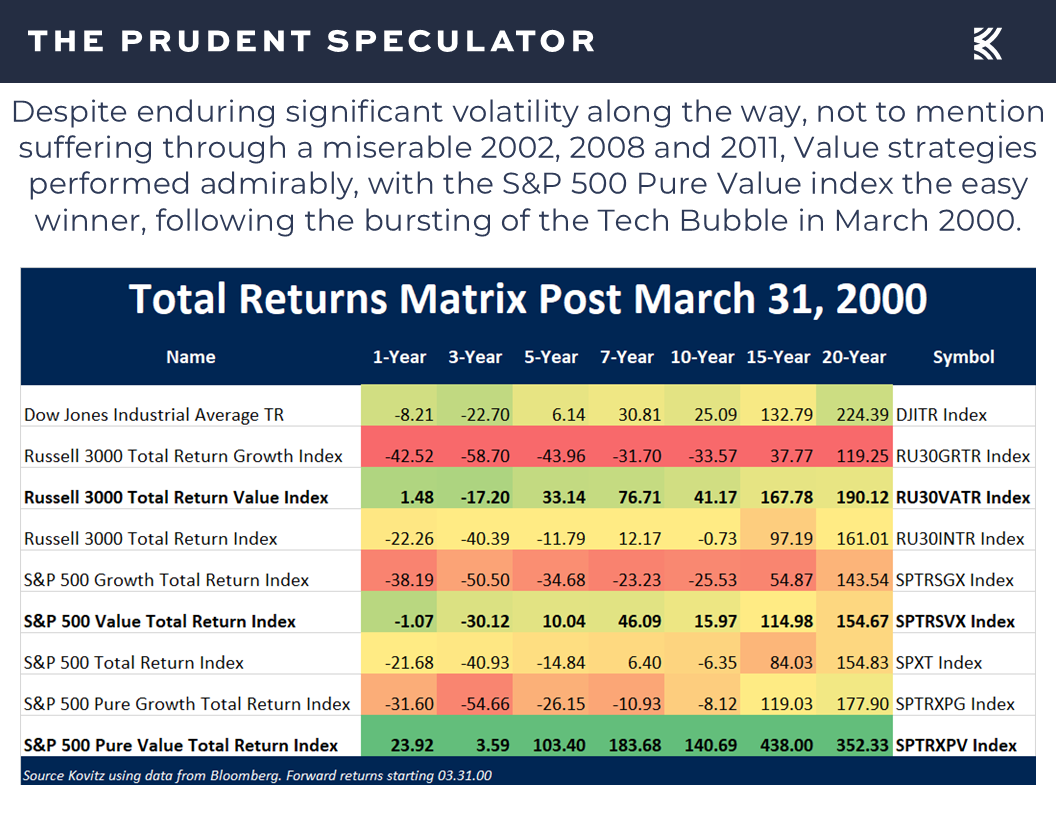
After all, it is a market of stocks and not simply a stock market…as was evidenced in recent weeks when the formerly high-flying A.I. trade suffered a major reversal, with many pundits citing similarities to the bursting of the Tech Bubble in early 2000…which turned out to be a major positive over the ensuing decade for Value vs. Growth.
A.I. Trade – Nvidia Earnings & Management Comments; Still Liking the Al Frank Way of Selling a Little and Keeping a Little
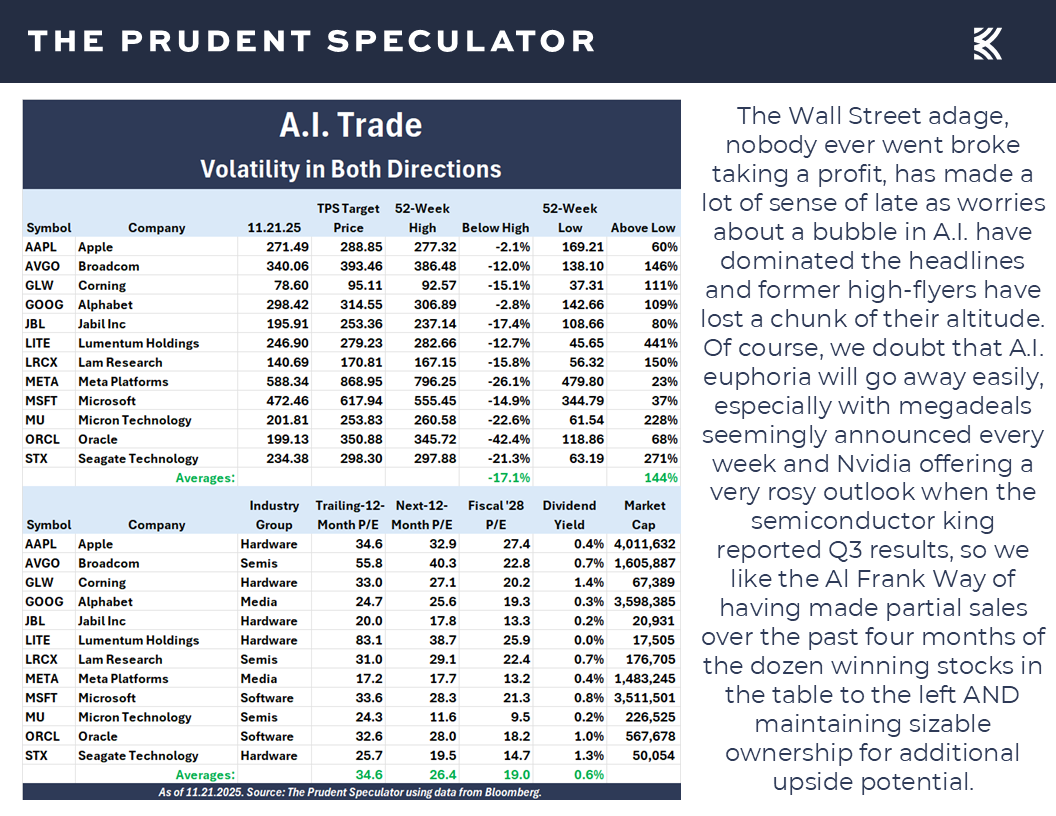
Of course, things are much different today than they were back at the turn of the millennium when profitless dot.com stocks were soaring. Today’s A.I.-exposed names are highly profitable and not overly expensive, especially given growth expectations over the next 12 months and out to fiscal 2028.
While A.I. stocks were already heading south, all eyes were on Nvidia’s (NVDA) Q3 report on Wednesday afternoon. The company, with a market capitalization exceeding $4 trillion, is the #1 name in the A.I. space and is preparing to launch a new generation of graphic processing units (GPU) based on the Blackwell architecture called RTX 50 series. For consumers, it’ll come equipped with fourth-generation RT cores for ray tracing and fifth-generation Tensor cores. Professional editions will be based on the Rubin platform and are designed specifically for massive workloads and video processing. Nvidia said they have ‘visibility’ to $0.5 trillion of orders through the end of 2026 for their new units.
Nvidia’s Q3 report was an important status check on the overall health of the A.I. infrastructure investment boom, and fortunately, it seems to have passed the test. The company earned $1.30 per share in the third quarter on $57.0 billion of revenue, up 62% year-over-year and nicely ahead of the $55.2 billion consensus estimate. Santa Clara’s finest grew in every major area and had an adjusted gross margin nearing 74%. The Q4 forecast, which included revenue guidance between $63.7 billion and $66.3 billion, exceeded the analyst consensus estimate by a whopping $3 billion, while the $5 billion of estimated operating expenses was on par with the consensus.
NVDA CFO Colette Kress said, “Demand for AI infrastructure continues to exceed our expectations. The clouds are sold out and our GPU installed base, both new and previous generations, including Blackwell, Hopper and Ampere, is fully utilized. Record Q3 data center revenue of $51 billion increased 66% year-over-year, a significant feat at our scale. Compute grew 56% year-over-year, driven primarily by the GB300 ramp, while networking more than doubled given the onset of NVLink scale up and robust double-digit growth across Spectrum-X Ethernet and Quantum-X InfiniBand. The world hyperscalers, $1 trillion industry, are transforming search, recommendations, and content understanding from classical machine learning to generative AI.”
Offering his take on a potential A.I. bubble, Nvidia CEO Jensen Huang said:
From our vantage point, we see something very different. As a reminder, NVIDIA is unlike any other accelerator. We excel at every phase of AI, from pre-training and post-training to inference. And with our two-decade investment in CUDA-X Acceleration Libraries, we are also exceptional at science and engineering simulations, computer graphics, and structured data processing to classical machine learning. The world is going — is undergoing three massive platform shifts at once, the first time since the dawn of Moore’s law. NVIDIA is uniquely addressing each of the three transformations.
The first transition is from CPU general purpose computing to GPU accelerated computing, as Moore’s law slows. The world has a massive investment in non-AI software, from data processing to science and engineering simulations, representing hundreds of billions of dollars in compute — cloud computing spend each year. Many of these applications, which ran once exclusively on CPUs, are now rapidly shifting to CUDA GPUs. Accelerated computing has reached a tipping point. Secondly, AI has also reached a tipping point and is transforming existing applications while enabling entirely new ones. For existing applications, generative AI is replacing classical machine learning in search ranking, recommender systems, ad targeting, click-through prediction to content moderation, the very foundations of hyperscale infrastructure.
Meta’s GEM, a foundation model for ad recommendations trained on large-scale GPU clusters, exemplifies this shift. In Q2, Meta reported over a 5% increase in ad conversions on Instagram and 3% gain on Facebook feed, driven by generative AI-based GEM. Transitioning to generative AI represents substantial revenue gains for hyperscalers. Now a new wave is rising, agentic AI systems, capable of reasoning, planning, and using tools. From coding assistants like Cursor and Claude Code to radiology tools like Aidoc, legal assistants like Harvey, and AI chauffeurs like Tesla FSD and Waymo, these systems mark the next frontier of computing.
The fastest growing companies in the world today, OpenAI, Anthropic, xAI, Google, Cursor, Lovable, Replit, Cognition AI, OpenEvidence, Abridge, Tesla are pioneering agentic AI. So there are three massive platform shifts. The transition to accelerated computing is foundational and necessary, essential in a post Moore’s law era. The transition to generative AI is transformational and necessary, supercharging existing applications and business models. And the transition to agentic and physical AI will be revolutionary, giving rise to new applications, companies, products and services.
As you consider infrastructure investments, consider these three fundamental dynamics, each will contribute to infrastructure growth in the coming years. NVIDIA is chosen because our singular architecture enables all three transitions and does so for any form and modality of AI, across all industries, across every phase of AI, across all of the diverse computing needs in a cloud, and also from cloud to enterprise to robots, one architecture.
With Nvidia nearing an 8% weight in the S&P 500 index and an even-larger part of the market when considering that A.I. technology potential is being priced into stocks in virtually all corners of the market, investors were able to breathe a sigh of relief that the report was broadly positive, especially as there were jitters and some IT exposure unwinding earlier in the week.
A.I. exposure in our portfolios is a bit harder to pin down. After all, it’s fairly easy to draw a straight line to A.I. deals for Microsoft (MSFT – $472.12) or Intel (INTC – $34.50), but what about general retailer Target (TGT – $87.62), who plans to use ChatGPT for A.I.-assisted shopping?
We pulled up TPS Portfolio in Bloomberg and charted it by exposure relative to the base Russell 3000 index (which we might consider “the market”) and our benchmark Russell 3000 Value index. Compared to Value, the portfolio had a lower allocation to Financials and a higher exposure to Technology, with the reverse true when weighted against the market. TPS Portfolio is represented by a white bar, the Russell 3000 Value is a yellow dot and the base Russell 3000 index is a purple dot.
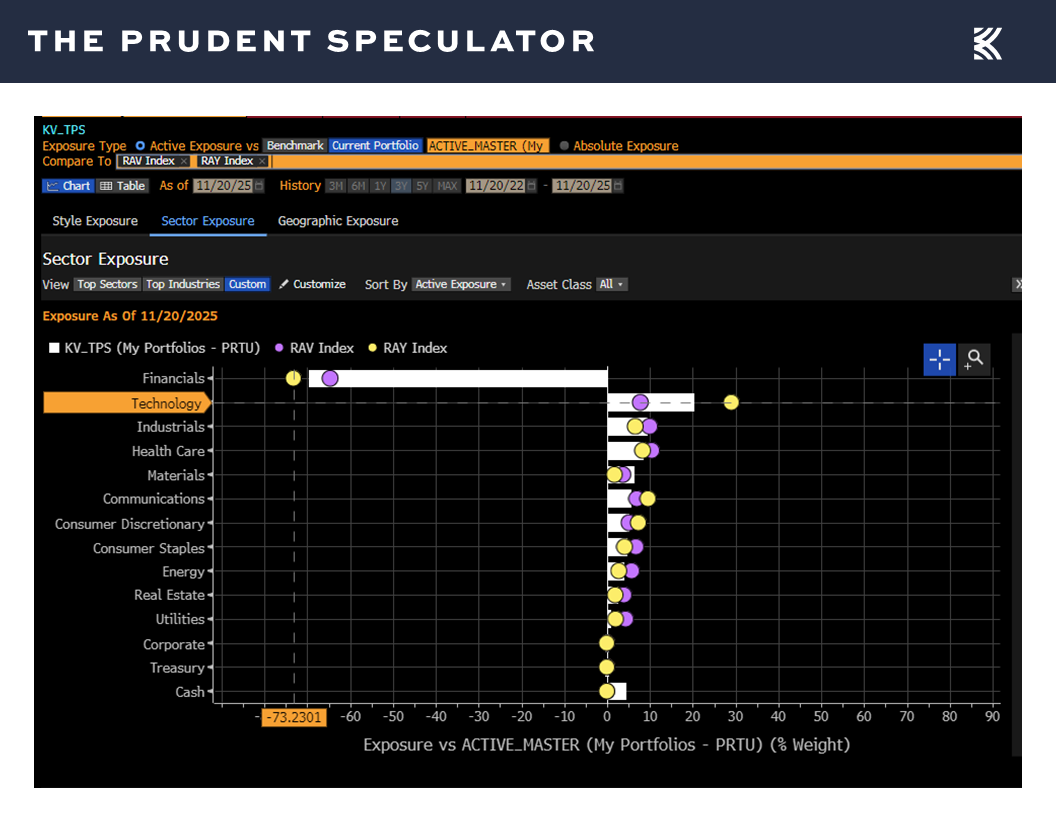
While we remain comfortable with our sector allocations, we have been careful to trim stocks that have approached (or exceeded) their published Target Prices in an effort to keep our single-factor exposure relatively reasonable. We’ll concede that some of our trims earlier in the year left quite a bit on the table, but our effort to employ broad diversification has been rewarded time and again.
It’s difficult to tell what part of A.I. spending is ‘real’ in that there are tons of promises being made and there seem to be few repercussions for not keeping them. For example, it’s difficult to tell how far along Oracle (ORCL – $198.76) is with its $500 billion investment commitment to President Trump earlier this year. Was that promise just window dressing because it included mostly money it was going to spend anyway? Or was that additional funding that Oracle had not previously planned to spend? We are picking on Oracle here because they made an obvious and very-public commitment, while our partial sale two months ago in the $300 range looks pretty good today. Yet, there are hundreds of others that have made similar commitments that in aggregate pale in comparison to the ones that get touted in the financial news. We continue to do our best to manage exposure prudently, both wanting to participate in the massive spending boom and protecting our portfolios from downside should spending slow down.
What’s hard to estimate is the Trump administration’s impact on A.I. In some situations, the president has been putting his thumb on the scale by going out of his way to protect U.S. industry and competitive advantages. In other situations, we believe he’s using A.I. as a negotiating tactic for other outcomes and is not necessarily acting in the best interest of our specific portfolio holdings. We were caught by surprise when news broke on Friday that the administration was considering selling Nvidia H200 chips to China, which would come as a request to Congress to reject the GAIN A.I. Act, a law that gives U.S.-based companies first dibs on chips that are set for export. Even as Tech stocks rebounded on that headline, we have been of the mind that the GAIN A.I. Act was a good thing, both for U.S. companies and for America in general. We are not convinced at this point that unwinding it is a good thing.
Value – More Reasonably Priced Relative to the Historical Norm
Tech stocks took it on the chin last week, and the Russell 3000 Value index cut into the Russell 3000 Growth index’s lead in the 2025 performance derby. The less-expensive area of the market continues to show solid, but not excessive, returns both on a near-, medium- and long-term basis,
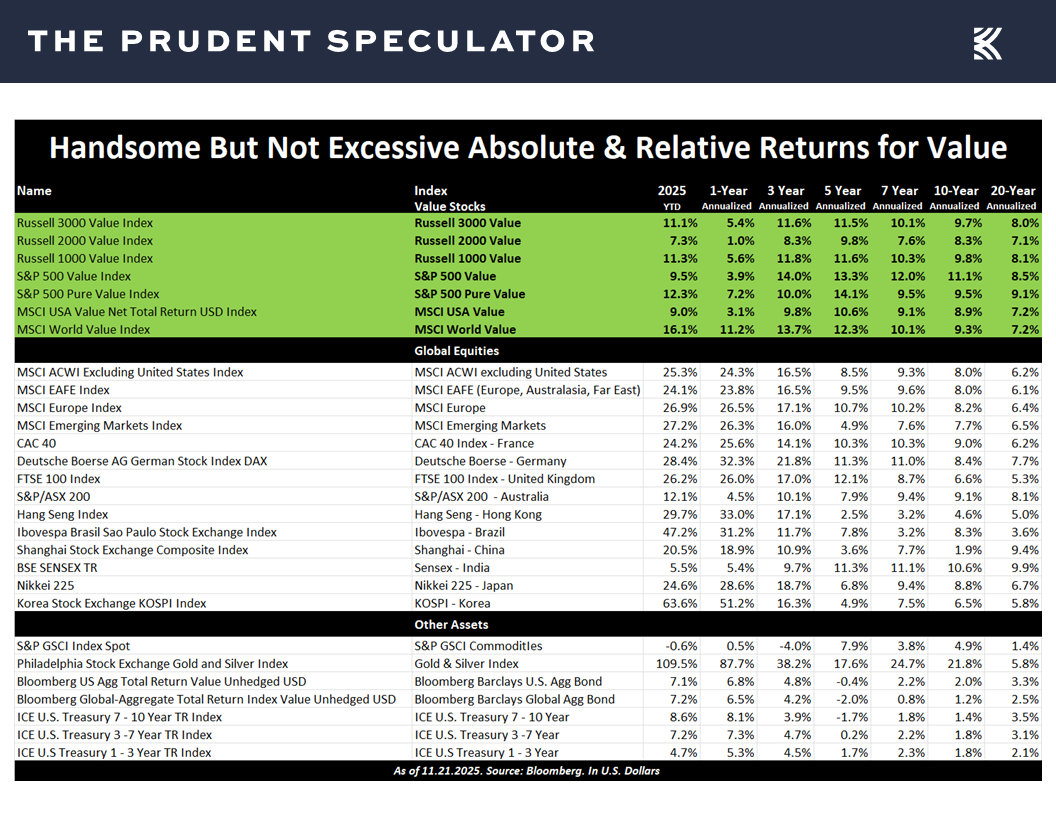
while valuations for Value are much less rich than Growth relative to their respective norms over the last three decades,
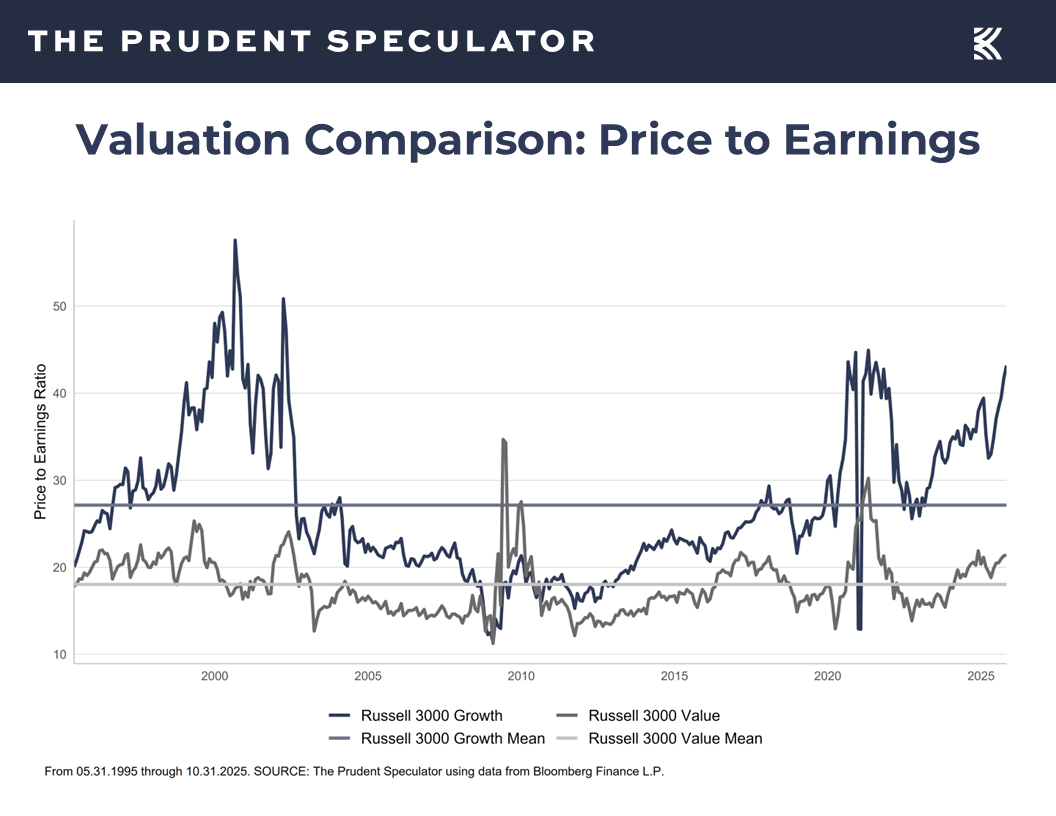
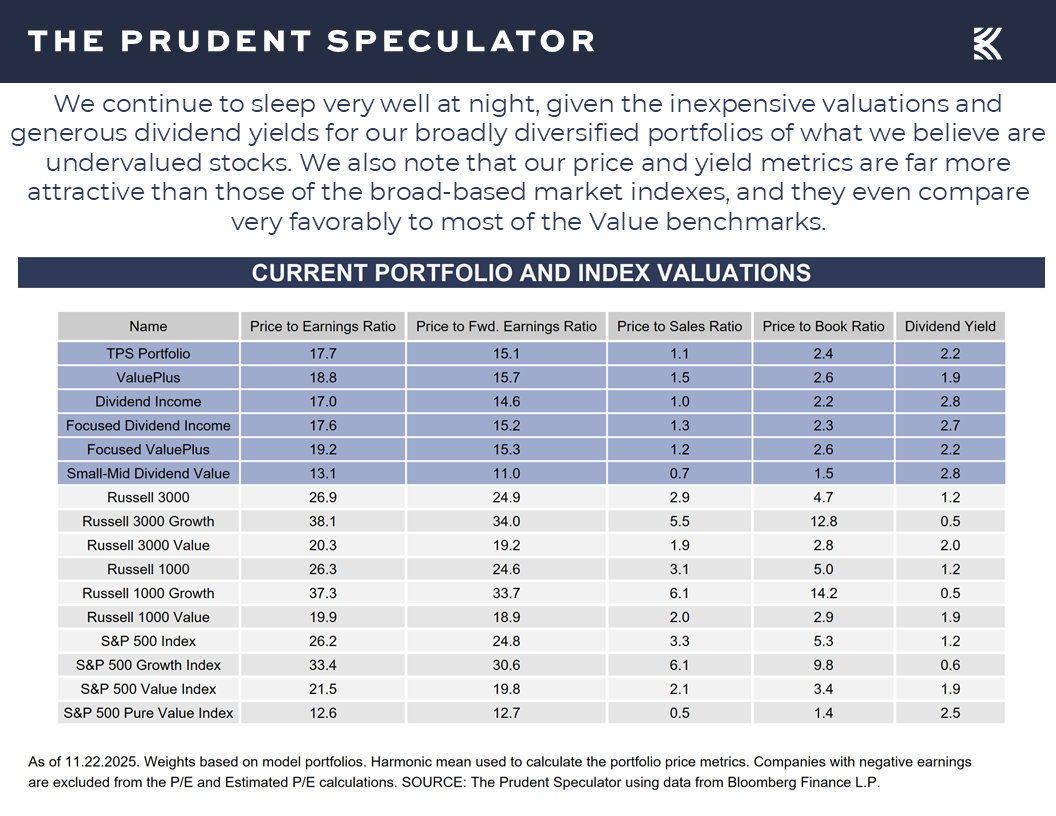
with our broadly diversified portfolios of what we believe are undervalued stocks sporting even more favorable metrics than nearly all the Value indexes, despite our sizable exposure to the A.I. trade.
We also note that Value Stocks and Dividend Payers have performed well, on average, when the Federal Reserve has been accommodative on monetary policy,
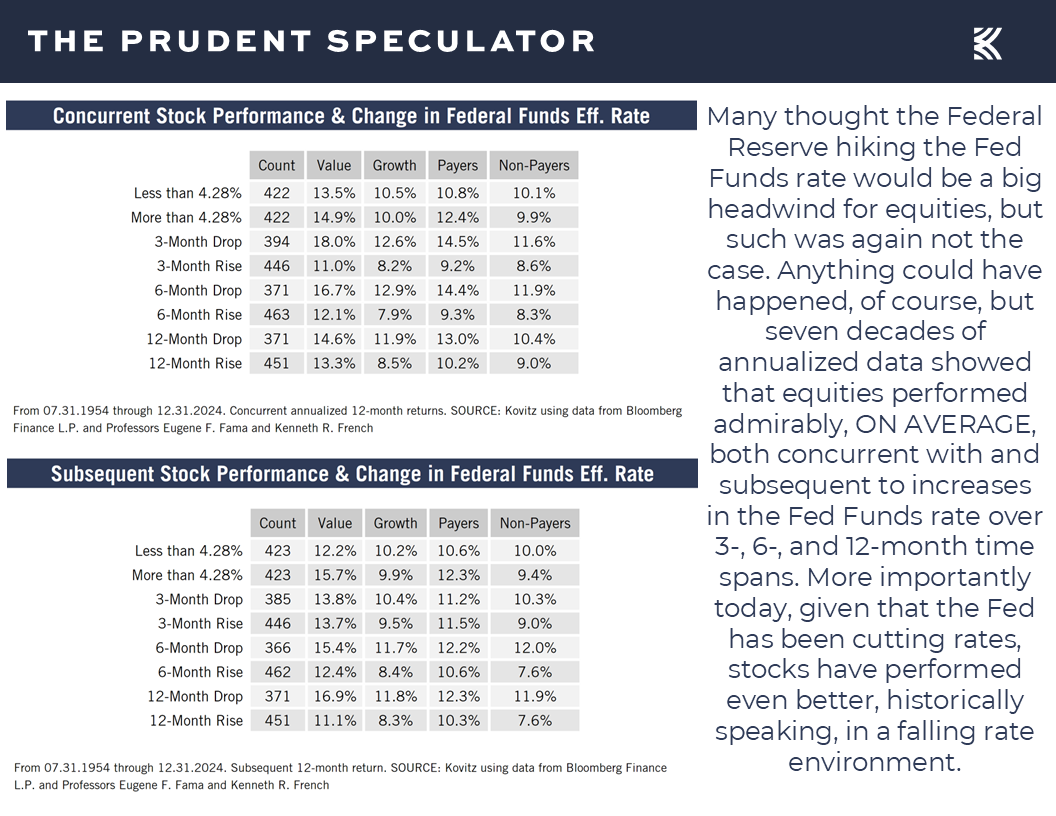
which is the situation today, with the Fed Fund futures market presently showing a roughly two-thirds probability of a cut in the benchmark lending rate at the upcoming December FOMC meeting and more than 3 cuts of 25 basis points by this time next year.
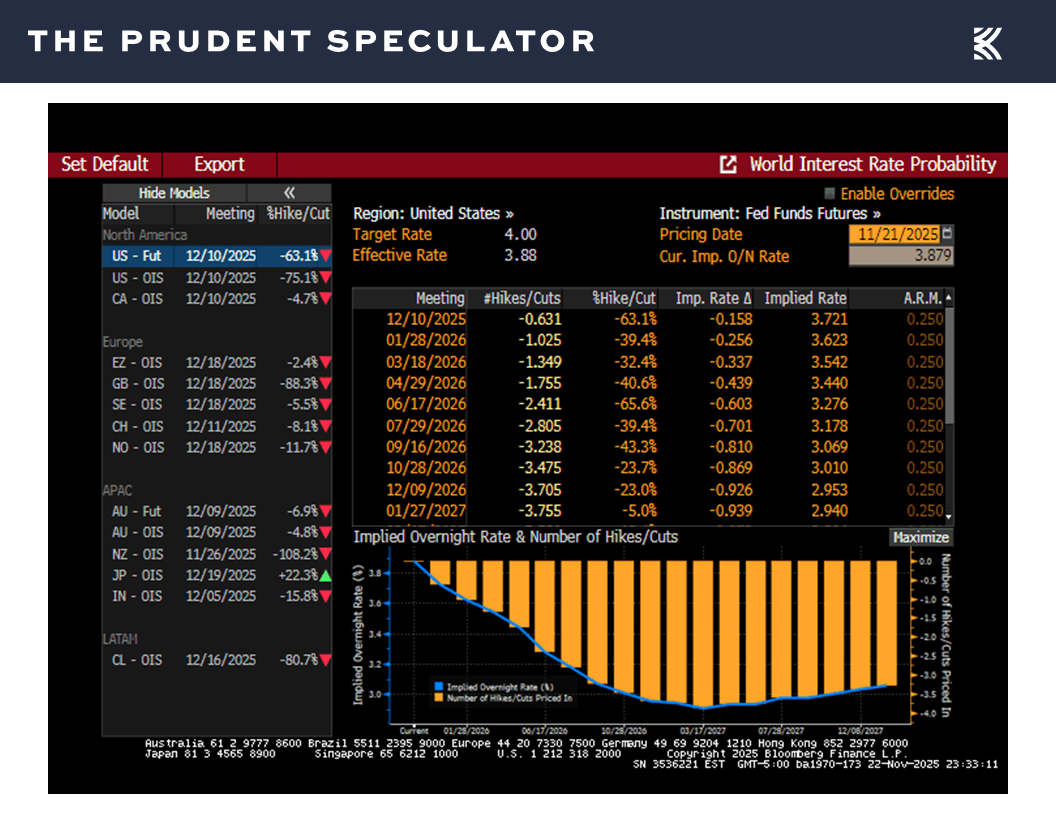
With New York Fed President John C. Williams stating on Friday, “My assessment is that the downside risks to employment have increased as the labor market has cooled, while the upside risks to inflation have lessened somewhat,” the chance of rate reductions actually improved last week, with data from Uncle Sam starting to roll in following the reopening of the U.S. government on November 13.
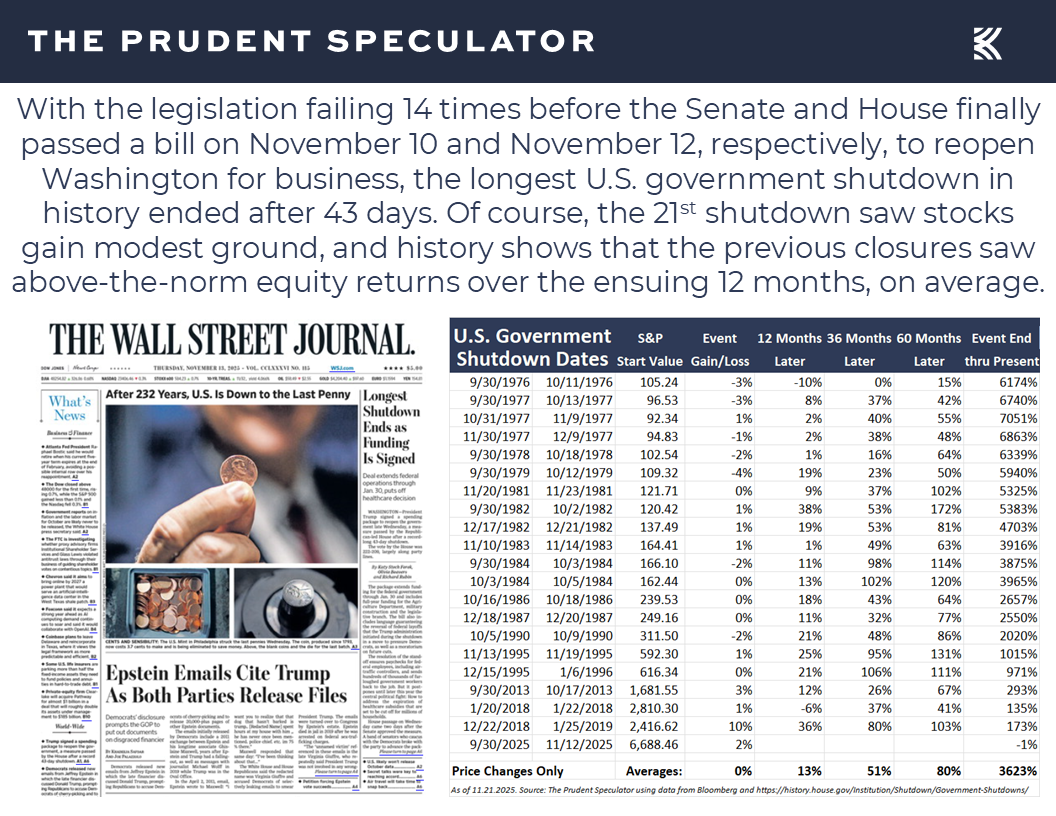
Econ – Mixed Numbers; Fed Still Expected to Cut Rates
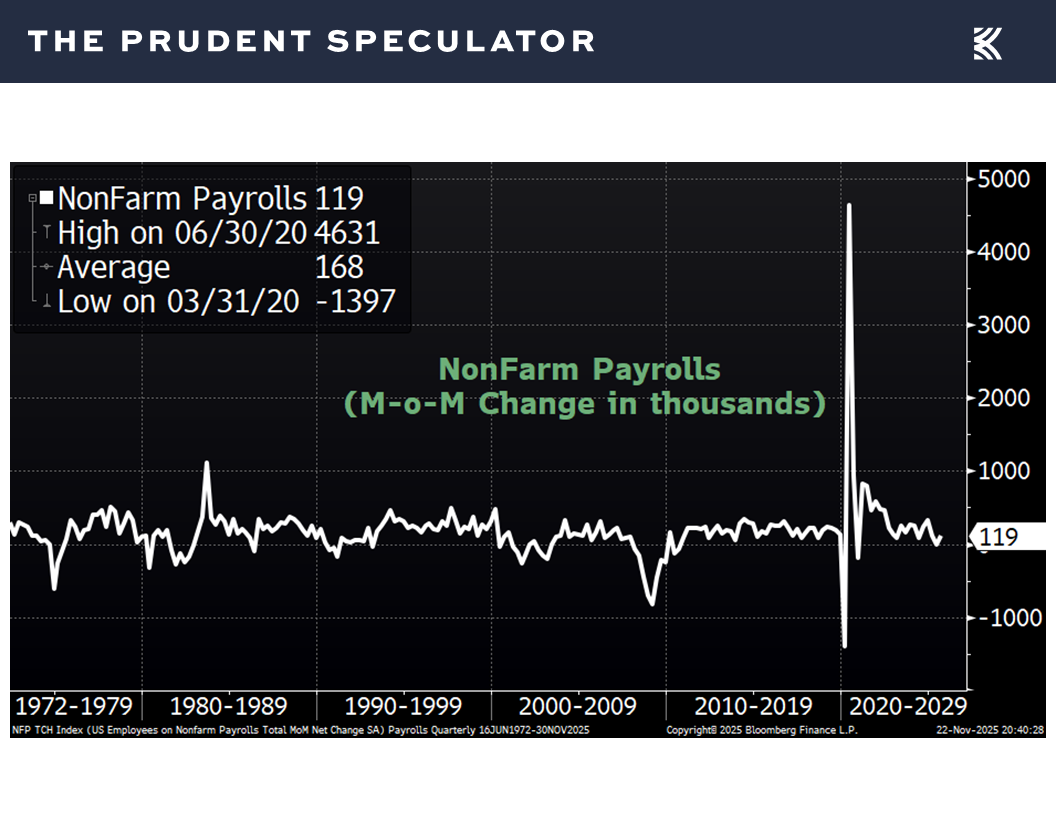
A better-than-expected increase of 119,000 payrolls in September,
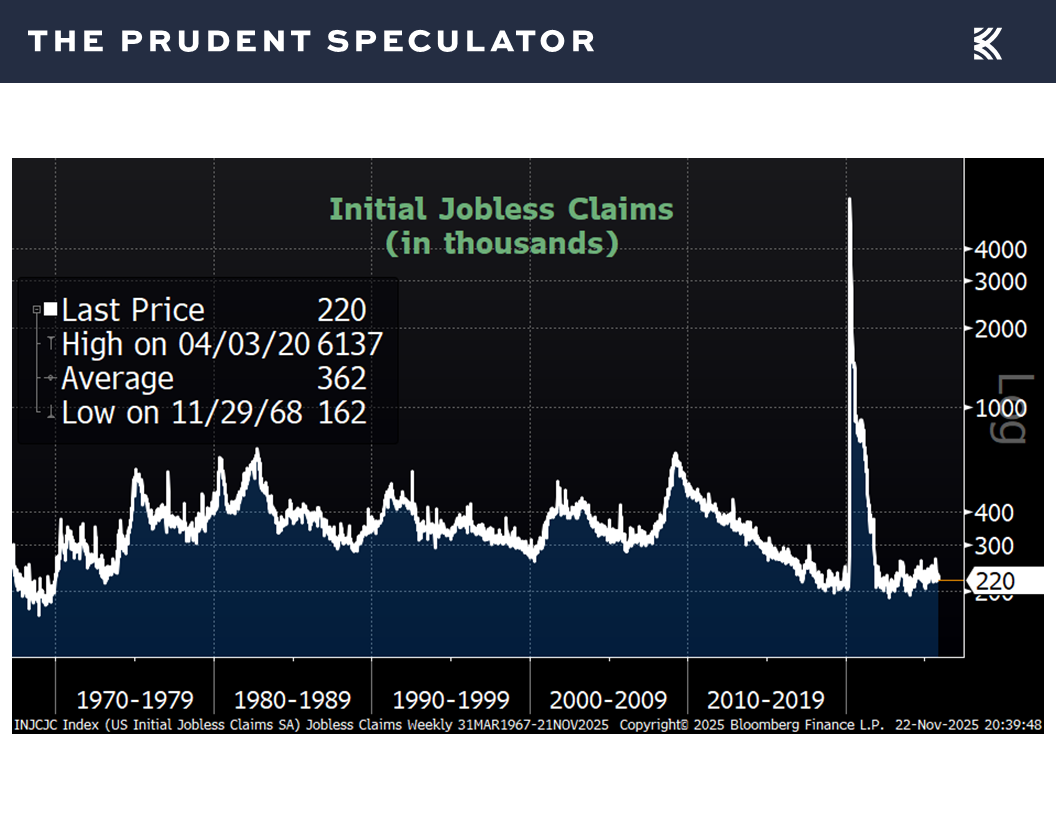
and initial filings for jobless benefits in the latest week continuing to reside near multi-generational lows,
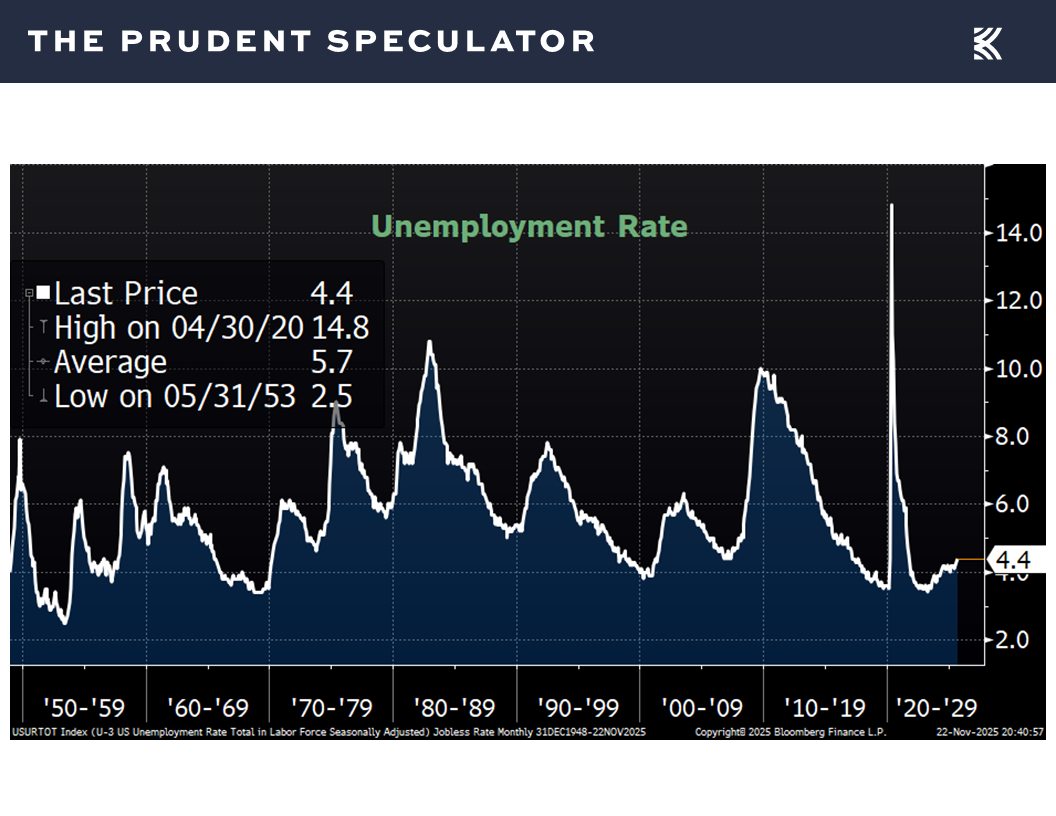
were offset by an increase in the September jobless rate to a four-year high of 4.4%,
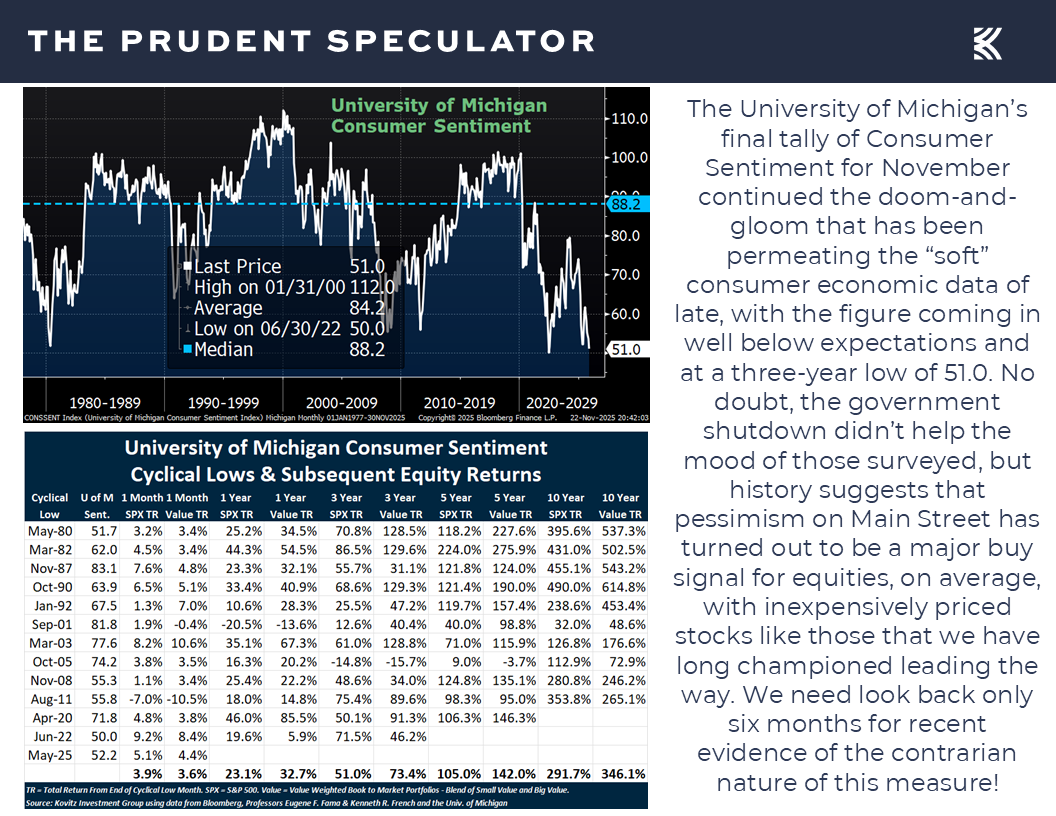
and the final reading on consumer sentiment for November, per the University of Michigan, remaining near record-low levels.
Sentiment – History Shows it has Paid to be Greedy When Others are Fearful
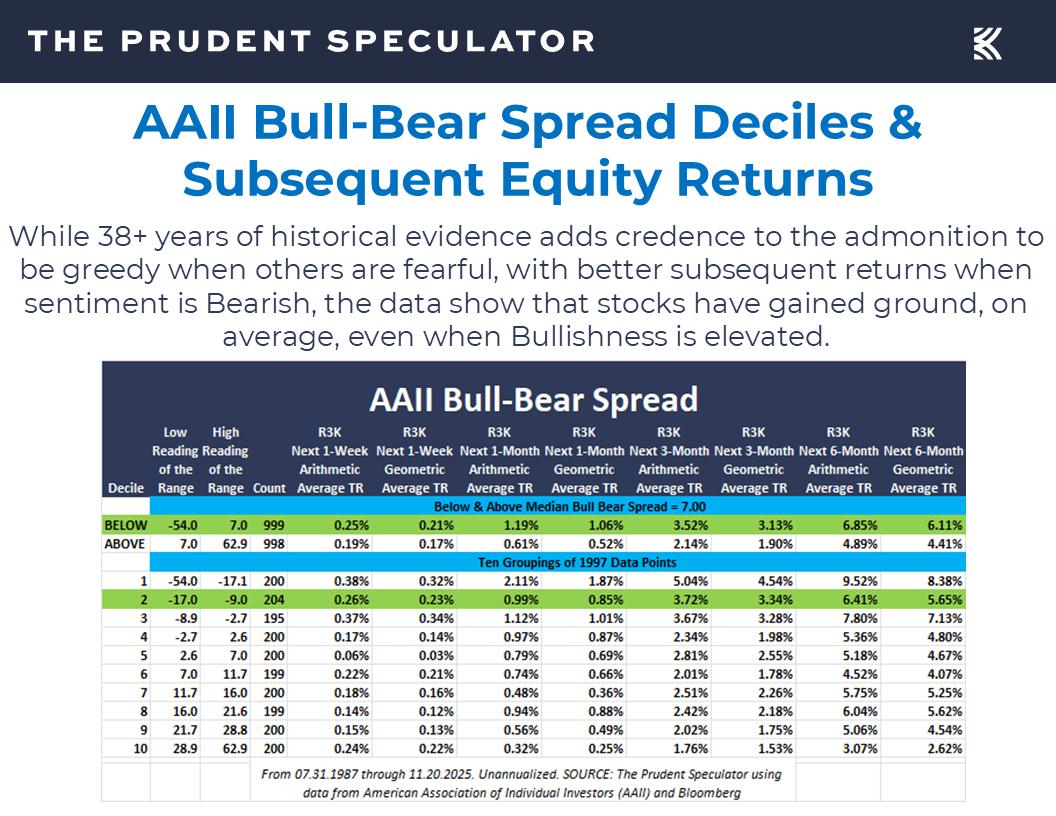
While conditions are always different each time and today’s highly polarized political climate is skewing the numbers lower, it is interesting that the Michigan reading on the mood of the consumer and the Bull-Bear Survey of investor sentiment on Main Street,
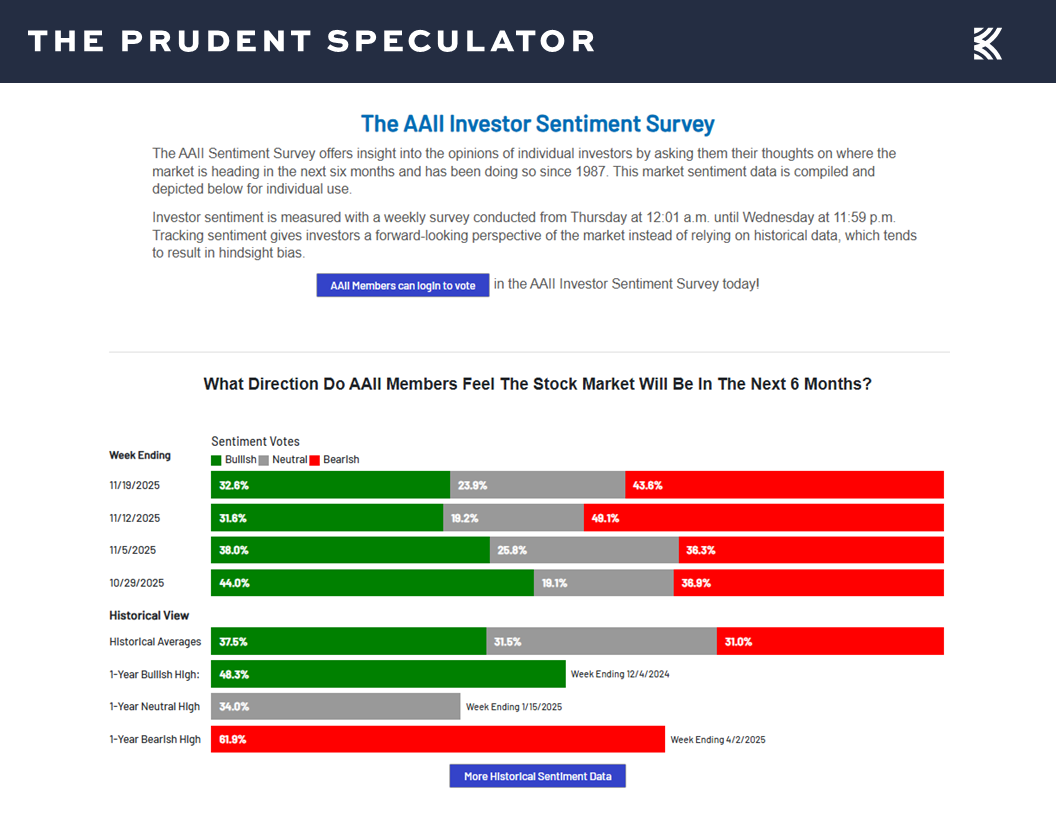
can be viewed as contraindicators for the equity markets, given that they suggest it often pays to be optimistic when others are pessimistic.
Patience – Volatility Always Part of the Process, but Upward Long-Term Trend
To be sure, we remain braced for additional downside volatility, as the 5% setback the S&P 500 just endured has happened more than 3 times per year on average,
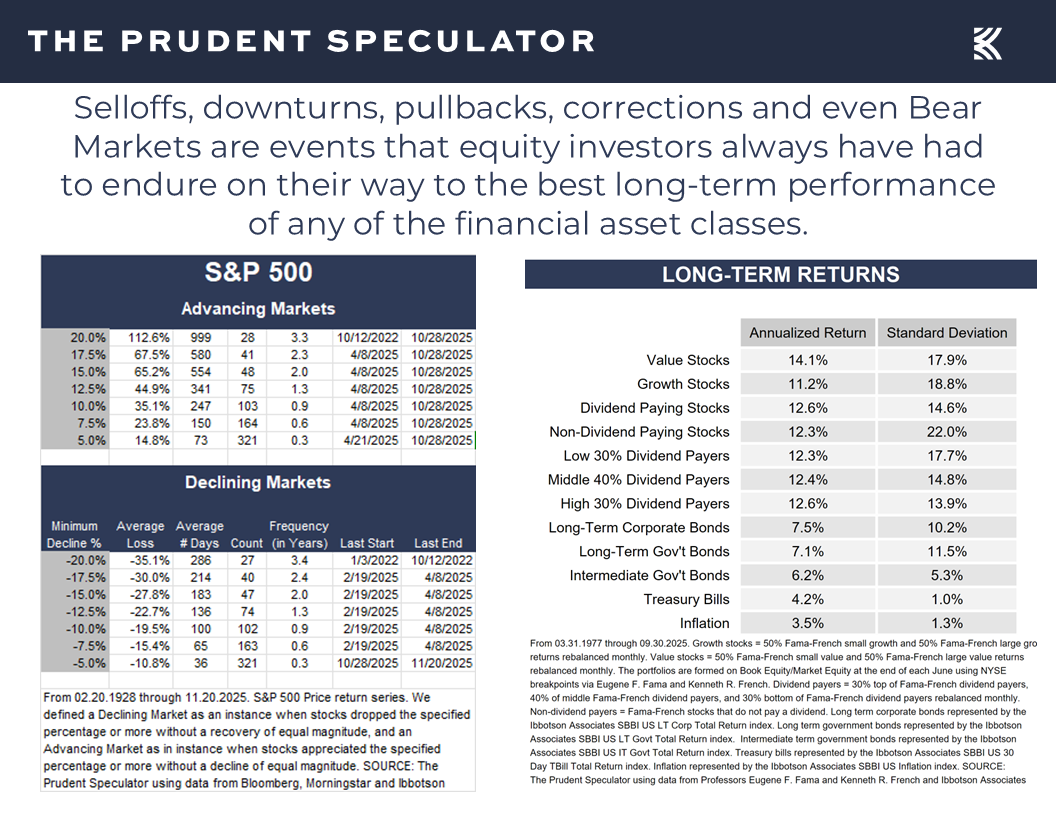
even as equities have proved very rewarding for those with the patience and discipline to stick with them through thick and thin.
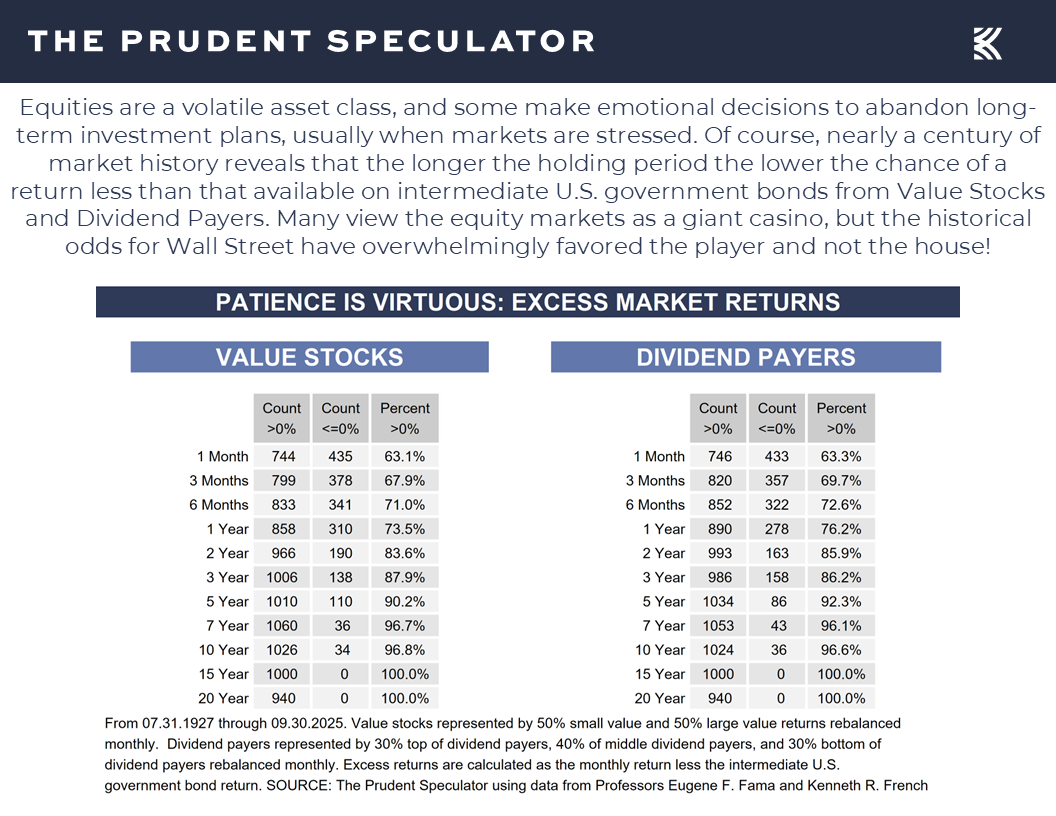
Happily, while we know that Bear Markets are also part of the investment process,
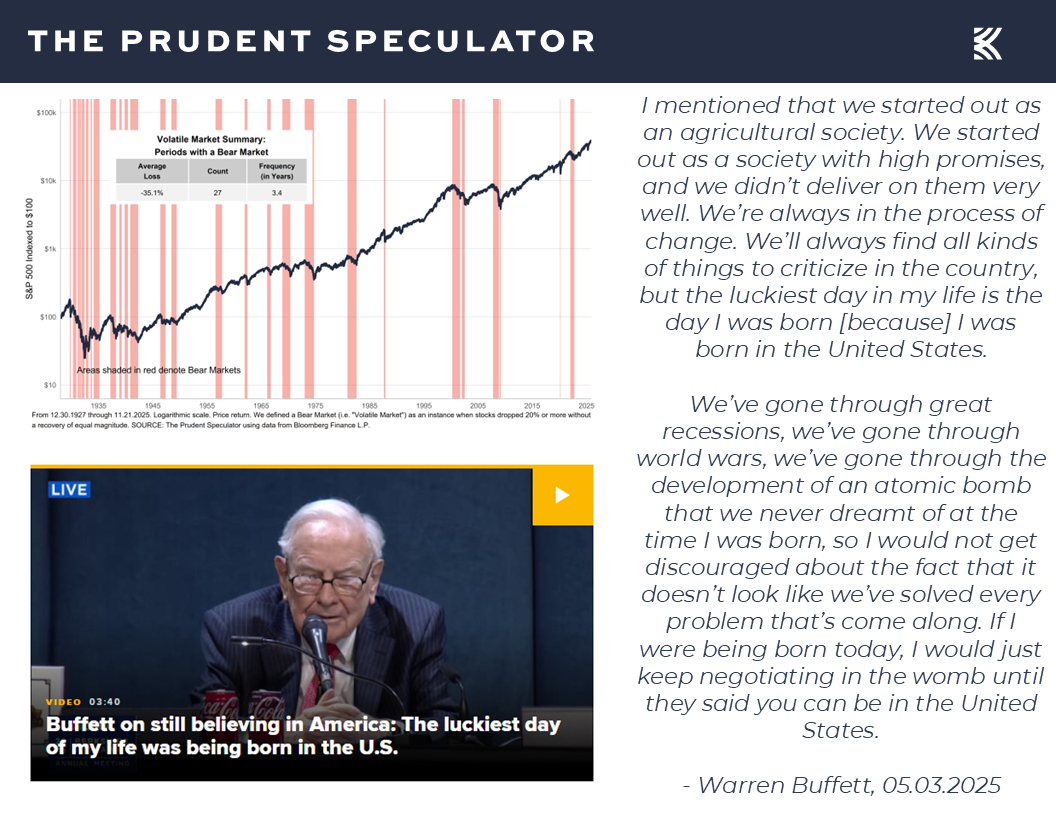
including a 20% intraday decline less than eight months ago,
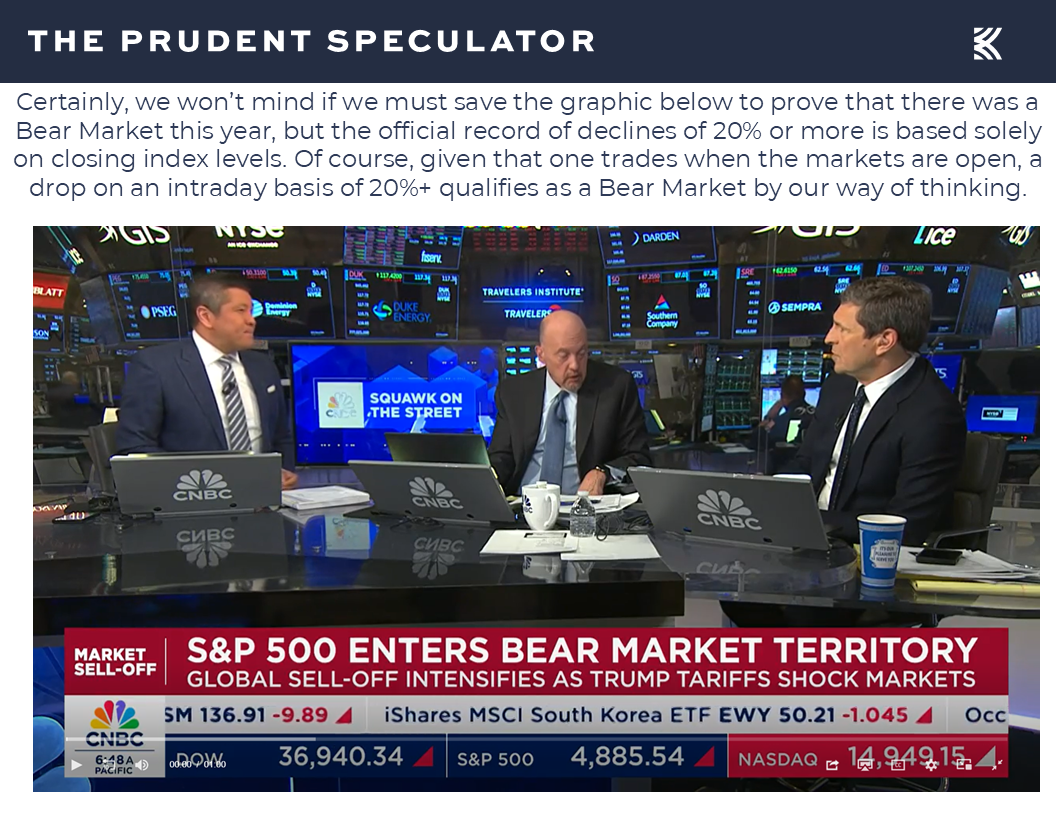
and disconcerting headlines are not easily ignored, stocks have overcome all prior downturns in the fullness of time,

as the long-term trend in corporate profits has been higher,
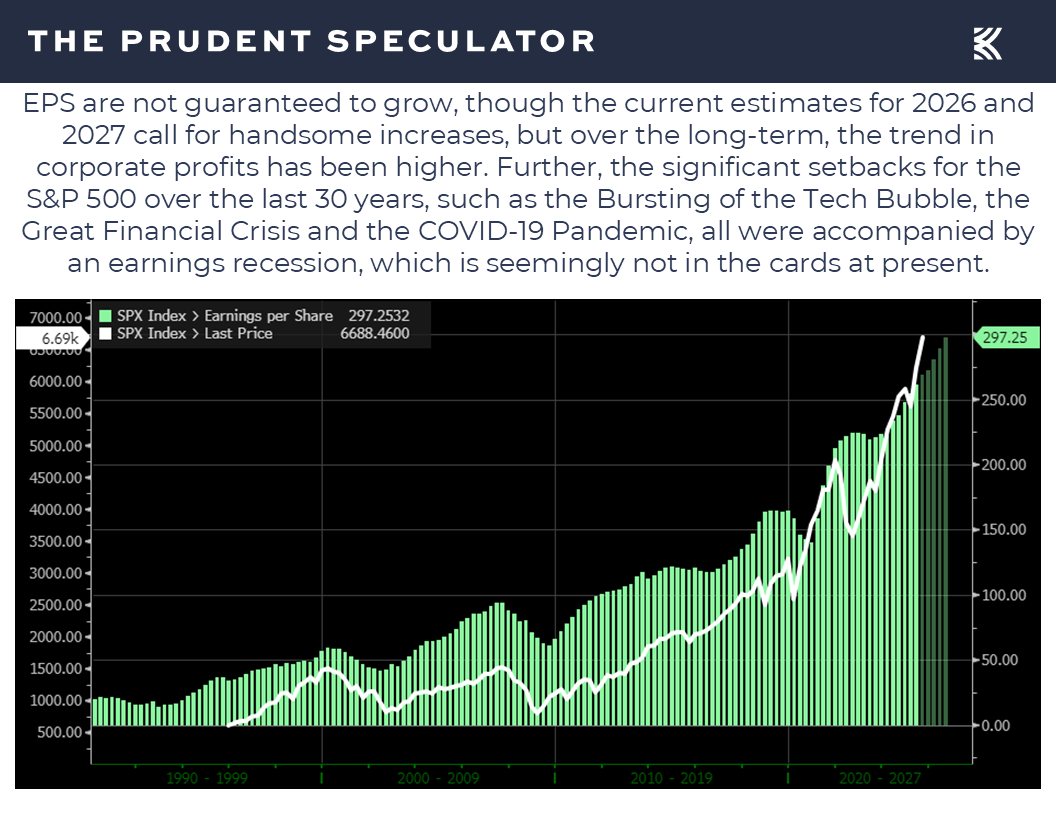
with a continuation of those increases in EPS the current outlook for the balance of this year and in 2026.
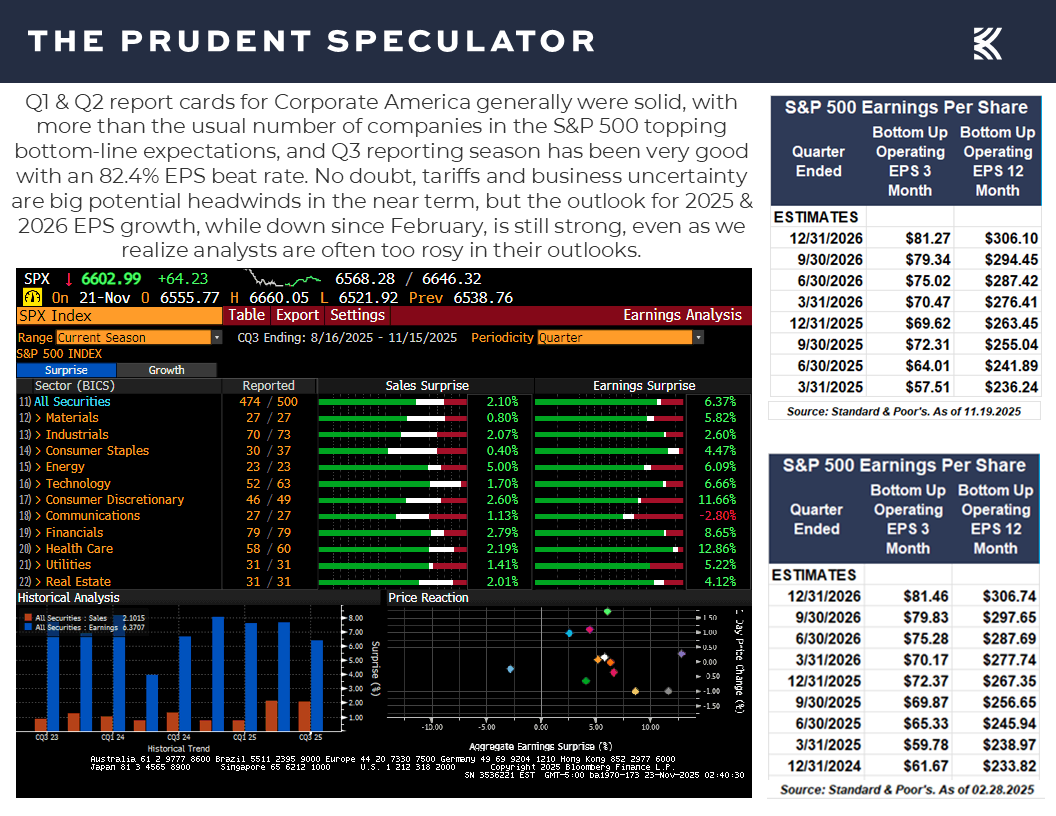
Stock News – Updates on six stocks across four different sector
Keeping in mind that all stocks are rated as a “Buy” until such time as they are a “Sell,” a listing of all current recommendations is available for download via the following link:
https://theprudentspeculator.com/dashboard/. We also offer the reminder that any sales we make for our newsletter strategies are announced via our
Sales Alerts. Jason Clark, Chris Quigley and Zack Tart take a look at earnings reports and other market-moving news of note out last week for more than a few of our recommendations.

Kovitz Investment Group Partners, LLC (“Kovitz”) is an investment adviser registered with the Securities and Exchange Commission. This report should only be considered as a tool in any investment decision and should not be used by itself to make investment decisions. Opinions expressed are only our current opinions or our opinions on the posting date. Any graphs, data, or information in this publication are considered reliably sourced, but no representation is made that it is accurate or complete and should not be relied upon as such. This information is subject to change without notice at any time, based on market and other conditions. Past performance is not indicative of future results, which may vary.

A.I Trade, Value, Economics, Earnings and more Stocks News
The Prudent Speculator Weekly Commentary is expertly curated every week as a valuable resource for stock market news, investing tips, business insights, and economic trends as it relates to value stock investing. In this week’s Market Commentary, we discuss A.I Trade, Value, Economics, Earnings and more Stock News. We also include a short preview of our specific stock picks for the week, the entire list is available only to our community of loyal subscribers.
Executive Summary
Webinar – Dividends & Diversification Link & 30 Undervalued Stocks
A.I. Trade – Nvidia Earnings & Management Comments; Still Liking the Al Frank Way of Selling a Little and Keeping a Little
Value – More Reasonably Priced Relative to the Historical Norm
Econ – Mixed Numbers; Fed Still Expected to Cut Rates
Sentiment – History Shows it has Paid to be Greedy When Others are Fearful
Patience – Volatility Always Part of the Process, but Upward Long-Term Trend
Earnings – Solid Growth Still the Forecast
Stock News – Updates on COF, MDT, LOW, WMT, TGT & KLIC
Webinar – Dividends & Diversification Link & 30 Undervalued Stocks
We want to thank all of those who attended our latest Webinar: Dividends & Diversification: Practical Strategies for Putting Capital to Work Across a Broadly Diversified Portfolio.
Here is a link to view the presentation…
Dividends & Diversification Webinar
…and here is the table of undervalued stock picks we offered, all of which had a dividend yield more than twice that of the S&P 500.
No doubt, readers will observe that the majority of the stocks on the Webinar list are down on the year…which is part of the reason they were highlighted. It has been a terrific year overall thus far on both an absolute and relative basis, so we could have featured our winning picks, but we always believe in full transparency, plus we assume that folks are looking to put new money to work, so we think they would appreciate a listing of names that have yet to have much, if any, time in the sun.
After all, it is a market of stocks and not simply a stock market…as was evidenced in recent weeks when the formerly high-flying A.I. trade suffered a major reversal, with many pundits citing similarities to the bursting of the Tech Bubble in early 2000…which turned out to be a major positive over the ensuing decade for Value vs. Growth.
A.I. Trade – Nvidia Earnings & Management Comments; Still Liking the Al Frank Way of Selling a Little and Keeping a Little
Of course, things are much different today than they were back at the turn of the millennium when profitless dot.com stocks were soaring. Today’s A.I.-exposed names are highly profitable and not overly expensive, especially given growth expectations over the next 12 months and out to fiscal 2028.
While A.I. stocks were already heading south, all eyes were on Nvidia’s (NVDA) Q3 report on Wednesday afternoon. The company, with a market capitalization exceeding $4 trillion, is the #1 name in the A.I. space and is preparing to launch a new generation of graphic processing units (GPU) based on the Blackwell architecture called RTX 50 series. For consumers, it’ll come equipped with fourth-generation RT cores for ray tracing and fifth-generation Tensor cores. Professional editions will be based on the Rubin platform and are designed specifically for massive workloads and video processing. Nvidia said they have ‘visibility’ to $0.5 trillion of orders through the end of 2026 for their new units.
Nvidia’s Q3 report was an important status check on the overall health of the A.I. infrastructure investment boom, and fortunately, it seems to have passed the test. The company earned $1.30 per share in the third quarter on $57.0 billion of revenue, up 62% year-over-year and nicely ahead of the $55.2 billion consensus estimate. Santa Clara’s finest grew in every major area and had an adjusted gross margin nearing 74%. The Q4 forecast, which included revenue guidance between $63.7 billion and $66.3 billion, exceeded the analyst consensus estimate by a whopping $3 billion, while the $5 billion of estimated operating expenses was on par with the consensus.
NVDA CFO Colette Kress said, “Demand for AI infrastructure continues to exceed our expectations. The clouds are sold out and our GPU installed base, both new and previous generations, including Blackwell, Hopper and Ampere, is fully utilized. Record Q3 data center revenue of $51 billion increased 66% year-over-year, a significant feat at our scale. Compute grew 56% year-over-year, driven primarily by the GB300 ramp, while networking more than doubled given the onset of NVLink scale up and robust double-digit growth across Spectrum-X Ethernet and Quantum-X InfiniBand. The world hyperscalers, $1 trillion industry, are transforming search, recommendations, and content understanding from classical machine learning to generative AI.”
Offering his take on a potential A.I. bubble, Nvidia CEO Jensen Huang said:
From our vantage point, we see something very different. As a reminder, NVIDIA is unlike any other accelerator. We excel at every phase of AI, from pre-training and post-training to inference. And with our two-decade investment in CUDA-X Acceleration Libraries, we are also exceptional at science and engineering simulations, computer graphics, and structured data processing to classical machine learning. The world is going — is undergoing three massive platform shifts at once, the first time since the dawn of Moore’s law. NVIDIA is uniquely addressing each of the three transformations.
The first transition is from CPU general purpose computing to GPU accelerated computing, as Moore’s law slows. The world has a massive investment in non-AI software, from data processing to science and engineering simulations, representing hundreds of billions of dollars in compute — cloud computing spend each year. Many of these applications, which ran once exclusively on CPUs, are now rapidly shifting to CUDA GPUs. Accelerated computing has reached a tipping point. Secondly, AI has also reached a tipping point and is transforming existing applications while enabling entirely new ones. For existing applications, generative AI is replacing classical machine learning in search ranking, recommender systems, ad targeting, click-through prediction to content moderation, the very foundations of hyperscale infrastructure.
Meta’s GEM, a foundation model for ad recommendations trained on large-scale GPU clusters, exemplifies this shift. In Q2, Meta reported over a 5% increase in ad conversions on Instagram and 3% gain on Facebook feed, driven by generative AI-based GEM. Transitioning to generative AI represents substantial revenue gains for hyperscalers. Now a new wave is rising, agentic AI systems, capable of reasoning, planning, and using tools. From coding assistants like Cursor and Claude Code to radiology tools like Aidoc, legal assistants like Harvey, and AI chauffeurs like Tesla FSD and Waymo, these systems mark the next frontier of computing.
The fastest growing companies in the world today, OpenAI, Anthropic, xAI, Google, Cursor, Lovable, Replit, Cognition AI, OpenEvidence, Abridge, Tesla are pioneering agentic AI. So there are three massive platform shifts. The transition to accelerated computing is foundational and necessary, essential in a post Moore’s law era. The transition to generative AI is transformational and necessary, supercharging existing applications and business models. And the transition to agentic and physical AI will be revolutionary, giving rise to new applications, companies, products and services.
As you consider infrastructure investments, consider these three fundamental dynamics, each will contribute to infrastructure growth in the coming years. NVIDIA is chosen because our singular architecture enables all three transitions and does so for any form and modality of AI, across all industries, across every phase of AI, across all of the diverse computing needs in a cloud, and also from cloud to enterprise to robots, one architecture.
With Nvidia nearing an 8% weight in the S&P 500 index and an even-larger part of the market when considering that A.I. technology potential is being priced into stocks in virtually all corners of the market, investors were able to breathe a sigh of relief that the report was broadly positive, especially as there were jitters and some IT exposure unwinding earlier in the week.
A.I. exposure in our portfolios is a bit harder to pin down. After all, it’s fairly easy to draw a straight line to A.I. deals for Microsoft (MSFT – $472.12) or Intel (INTC – $34.50), but what about general retailer Target (TGT – $87.62), who plans to use ChatGPT for A.I.-assisted shopping?
We pulled up TPS Portfolio in Bloomberg and charted it by exposure relative to the base Russell 3000 index (which we might consider “the market”) and our benchmark Russell 3000 Value index. Compared to Value, the portfolio had a lower allocation to Financials and a higher exposure to Technology, with the reverse true when weighted against the market. TPS Portfolio is represented by a white bar, the Russell 3000 Value is a yellow dot and the base Russell 3000 index is a purple dot.
While we remain comfortable with our sector allocations, we have been careful to trim stocks that have approached (or exceeded) their published Target Prices in an effort to keep our single-factor exposure relatively reasonable. We’ll concede that some of our trims earlier in the year left quite a bit on the table, but our effort to employ broad diversification has been rewarded time and again.
It’s difficult to tell what part of A.I. spending is ‘real’ in that there are tons of promises being made and there seem to be few repercussions for not keeping them. For example, it’s difficult to tell how far along Oracle (ORCL – $198.76) is with its $500 billion investment commitment to President Trump earlier this year. Was that promise just window dressing because it included mostly money it was going to spend anyway? Or was that additional funding that Oracle had not previously planned to spend? We are picking on Oracle here because they made an obvious and very-public commitment, while our partial sale two months ago in the $300 range looks pretty good today. Yet, there are hundreds of others that have made similar commitments that in aggregate pale in comparison to the ones that get touted in the financial news. We continue to do our best to manage exposure prudently, both wanting to participate in the massive spending boom and protecting our portfolios from downside should spending slow down.
What’s hard to estimate is the Trump administration’s impact on A.I. In some situations, the president has been putting his thumb on the scale by going out of his way to protect U.S. industry and competitive advantages. In other situations, we believe he’s using A.I. as a negotiating tactic for other outcomes and is not necessarily acting in the best interest of our specific portfolio holdings. We were caught by surprise when news broke on Friday that the administration was considering selling Nvidia H200 chips to China, which would come as a request to Congress to reject the GAIN A.I. Act, a law that gives U.S.-based companies first dibs on chips that are set for export. Even as Tech stocks rebounded on that headline, we have been of the mind that the GAIN A.I. Act was a good thing, both for U.S. companies and for America in general. We are not convinced at this point that unwinding it is a good thing.
Value – More Reasonably Priced Relative to the Historical Norm
Tech stocks took it on the chin last week, and the Russell 3000 Value index cut into the Russell 3000 Growth index’s lead in the 2025 performance derby. The less-expensive area of the market continues to show solid, but not excessive, returns both on a near-, medium- and long-term basis,
while valuations for Value are much less rich than Growth relative to their respective norms over the last three decades,
with our broadly diversified portfolios of what we believe are undervalued stocks sporting even more favorable metrics than nearly all the Value indexes, despite our sizable exposure to the A.I. trade.
We also note that Value Stocks and Dividend Payers have performed well, on average, when the Federal Reserve has been accommodative on monetary policy,
which is the situation today, with the Fed Fund futures market presently showing a roughly two-thirds probability of a cut in the benchmark lending rate at the upcoming December FOMC meeting and more than 3 cuts of 25 basis points by this time next year.
With New York Fed President John C. Williams stating on Friday, “My assessment is that the downside risks to employment have increased as the labor market has cooled, while the upside risks to inflation have lessened somewhat,” the chance of rate reductions actually improved last week, with data from Uncle Sam starting to roll in following the reopening of the U.S. government on November 13.
Econ – Mixed Numbers; Fed Still Expected to Cut Rates
A better-than-expected increase of 119,000 payrolls in September,
and initial filings for jobless benefits in the latest week continuing to reside near multi-generational lows,
were offset by an increase in the September jobless rate to a four-year high of 4.4%,
and the final reading on consumer sentiment for November, per the University of Michigan, remaining near record-low levels.
Sentiment – History Shows it has Paid to be Greedy When Others are Fearful
While conditions are always different each time and today’s highly polarized political climate is skewing the numbers lower, it is interesting that the Michigan reading on the mood of the consumer and the Bull-Bear Survey of investor sentiment on Main Street,
can be viewed as contraindicators for the equity markets, given that they suggest it often pays to be optimistic when others are pessimistic.
Patience – Volatility Always Part of the Process, but Upward Long-Term Trend
To be sure, we remain braced for additional downside volatility, as the 5% setback the S&P 500 just endured has happened more than 3 times per year on average,
even as equities have proved very rewarding for those with the patience and discipline to stick with them through thick and thin.
Happily, while we know that Bear Markets are also part of the investment process,
including a 20% intraday decline less than eight months ago,
and disconcerting headlines are not easily ignored, stocks have overcome all prior downturns in the fullness of time,
as the long-term trend in corporate profits has been higher,
with a continuation of those increases in EPS the current outlook for the balance of this year and in 2026.
Stock News – Updates on six stocks across four different sector
About the Author
John Buckingham
Explore
Popular Posts
Connect
Subscribe For Free Stock Picks
Get expert investing tips and market insights delivered straight to your inbox.