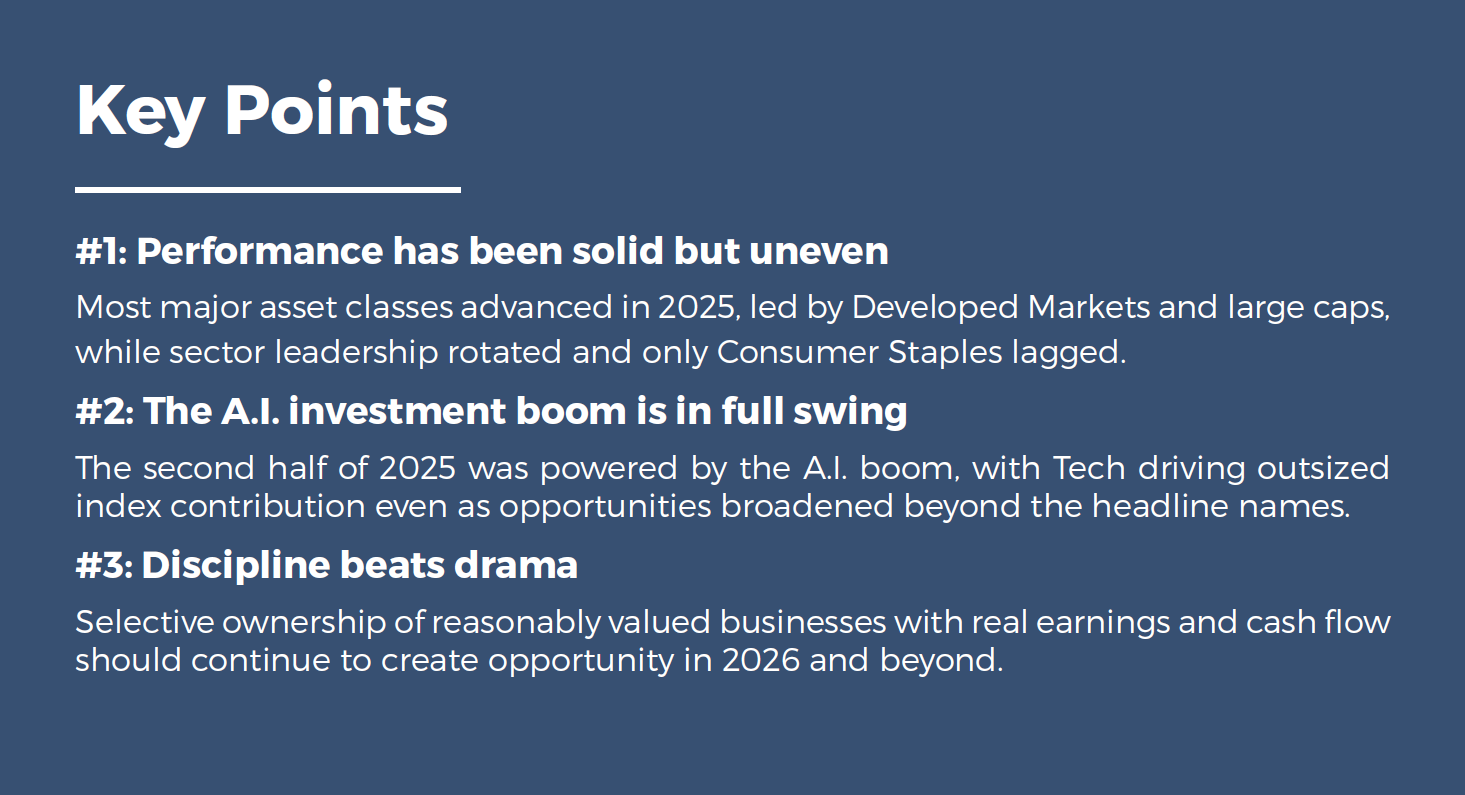

As always, the crystal ball is cloudy, but after three straight years of robust gains for equities, we would not be surprised to see some of the more-expensive investor favorites take a breather in 2026, with Value stocks enjoying much more time in the sun.
As we write this 2026 Stock Market Outlook, there are just a few days left in the year. We ended 2024 with a full list of concerns, including shifting power in D.C., the timing of rate cuts, the health of the U.S. economy and global geopolitical tensions. Our view was (and still is) that equities reward investors in the fullness of time, and those with broadly diversified portfolios of Value stocks may have an even better experience than the average investor, but it is hard to not feel some kind of angst about the road ahead.
As one might have suspected, the past eleven-plus months have had no shortage of drama. The year began on a hopeful note. With the presidential election in the rear-view mirror and President Trump’s new administration taking shape, markets rallied. The S&P 500 index reached an all-time high on February 19th, buoyed by expectations for continued pro-American policy.
On April 2nd, speaking from the White House’s Rose Garden, President Trump declared “Liberation Day” for U.S. trade policy. While hints of Trump’s plans had been circulating, few anticipated the sweeping nature of the announcement, which included three core components, including: 1) A Universal 10% Tariff: Effective April 5, 2025, a baseline 10% tariff was imposed on nearly all imported goods, with specific exclusions, 2) Reciprocal Tariffs: Starting April 9, 2025, higher tariffs ranging from 11% to 50% were applied to 86 countries. These rates were calculated based on the trade barriers those countries imposed on U.S. exports, aiming to mirror and counteract foreign trade practices and 3) A De Minimis Rule Adjustment: The administration closed the de minimis exemption for China, imposing duties on low-value imports that previously qualified for duty-free treatment.
Markets recoiled. Between April 2 and April 8, the S&P 500 dropped more than 12%, with Value stocks down 11.9% and Growth names falling 12.8%. The sudden escalation acted as a hard reset and an unambiguous reminder that policy risk remains alive and well.
Facing mounting political pressure and sharp investor backlash, the administration began dialing back key elements of the Liberation Day agenda. Some tariffs were delayed indefinitely, and others were watered down. The about face was welcomed by the markets.
RECENT MARKET PERFORMANCE
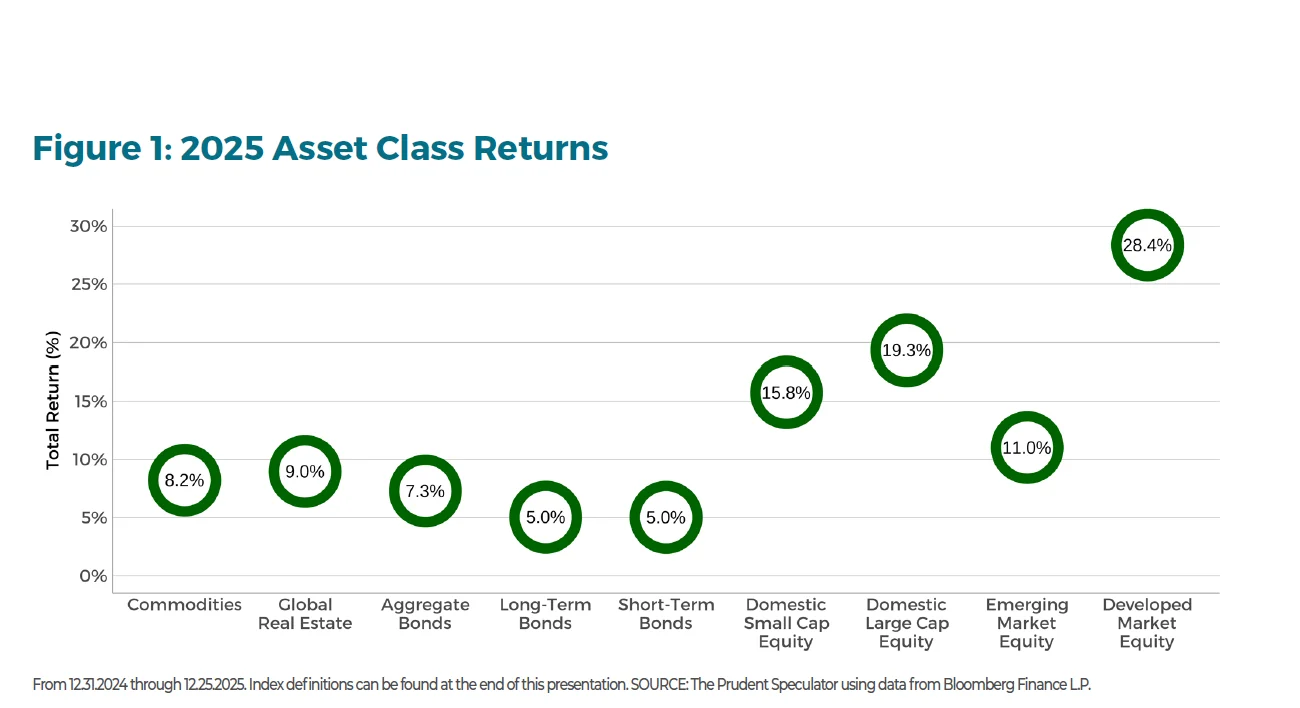
Figure 1 shows that things have been quite good this year and, in some cases, a long way ahead of long-term averages. All major asset classes have risen in value, led by Developed Market Equities (primarily thanks to Tech stocks) and Domestic Large Caps. Emerging Markets and Small Caps also turned in tidy returns. Bonds across the maturity spectrum also gained in the mid-single-digit range.
The second half of the year was largely propelled by a continuation of the “A.I. trade,” a massive investment boom that many expect to be as consequential as the introduction of the automobile. Capital expenditure expectations are eye-watering. Gartner, a market research shop, estimates that global A.I. spending will reach $1.5 trillion this year and exceed $2 trillion next.
While Tech accounted for about 40% of the Russell 3000’s 9% return since June 30, stocks saw broad growth with Consumer Staples the only one of the eleven GICS sectors to post a negative return. On a total return basis, the Health Care sector had the highest return, 20%, led by Eli Lily and Johnson & Johnson (JNJ). We must not forget Nvidia, which has dominated headlines for its outsized role in A.I. and tech, but the juggernaut actually slots in in the third position in top Tech contributors to return. The other three rounding out the top four are held in our portfolios: Apple (AAPL), Broadcom (AVGO) and Micron (MU).
Soaring share prices resulted in many trims (and a few outright sales) of highly valued stocks this year. We redeployed the proceeds into what we think are stocks that have more upside potential and reside on the Value end of the spectrum. We have been managing our A.I. exposure, although it is still a significant factor for us and broadly reflects our view that mountains of capital spending will result in technological advancements and boost bottom lines.
How do we measure A.I. success? That is not easy to define. Success in the Dot-Com Bubble earlier this millennium was measured by site traffic, clicks, eyeballs and users. In the A.I. world, a ‘token’ is the preferred yardstick. In the context of a large language model (LLM), a token is a small text unit the model processes.
A simple question like “what is the weather like?” might be broken into pieces such as “what”, “is”, “the”, “weather” and “like”, though tokens can also be fragments or punctuation. TThe model assigns probabilities to every possible next token based on the preceding context. It doesn’t search, reason or look up answers. It evaluates patterns it learned during training and selects the token with the highest probability.
Some companies have figured out how to monetize A.I. in short order, like Microsoft (MSFT) in their Office productivity suite or Meta Platforms’s (META) advertising engine. Some, like laser communications specialist Lumentum (LITE) or storage drive maker Seagate Technology (STX) are picks-and-shovels plays, which stand to benefit from the build out of the A.I. infrastructure necessary to support LLMs, but their success is not necessarily informed by a company’s ability to monetize the technology.
Other companies not directly in the A.I. space may take much longer to benefit from their capex. General merchandise retailer Target (TGT) is working to deploy A.I. to improve the customer shopping experience both in stores and online. The challenge is that the initial investment is expensive and they’ll need to see comparable sales improvements that exceed the amount they spent on the upgrades (both the initial investment and ongoing costs). TGT, with its newly installed CEO, is in need of a shake-up, but we are not expecting to see immediate results from what are likely to be large capital expenditures, but the stock is today trading for a multiple of earnings well below its historical norm, while shareholders receive a 4.6% dividend yield for their patience.
ECONOMIC BACKDROP
Fears of a recession have bubbled off and on for nearly half a decade, with the latest Bloomberg U.S. Recession Probability standing at 30%. We’ll admit that’s better than the 40% figure earlier in the year and half of 2023’s average, but investors waiting on the sidelines for dark days ahead have lost out on stellar returns, once again offering a reminder that folks tend to lose more money waiting for the next downturn than they would have in the correction or Bear Market itself.
As we write in our weekly Market Commentaries, broad economic health indicators remain in good shape and the Federal Reserve has been backing down the risk-free interest rate to help keep the American economic engine moving in the right direction. Of course, Jerome H. Powell and Co. are balancing several factors and they are adamant that they remain “data-dependent,” but we think the Fed is in a difficult position with little precedent for some of the things transpiring these days. Overall, it’s hard to be disappointed with today’s 3.75% target rate (down from 5.5%) and Fed futures markets predicting more than two more 25-basis-point cuts in the benchmark lending rate in 2026.
Further, we note that Chair Powell said a few weeks back, “The temporary shutdown of the federal government has likely weighed on economic activity in the current quarter, but these effects should be mostly offset by higher growth next quarter, reflecting the reopening. In our Summary of Economic Projections, the median participant projects that real GDP will rise 1.7% this year and 2.3% next year, somewhat stronger than projected in September.”
Of course, data from Uncle Sam has started to roll in following the reopening of the U.S. government on November 13 and the numbers paint a decidedly mixed picture.
‘Twas ever thus our founder Al Frank liked to say. Just since the December Fed Meeting, we have seen weaker-than-expected numbers on payrolls and New York manufacturing, but better-than-forecast figures on retail sales and consumer price inflation. Time will tell how strong U.S. GDP will be in 2026, but the projections for corporate profit growth remain strong, with analyst estimates having ratcheted higher of late.
VALUATIONS AND SENTIMENT RESET
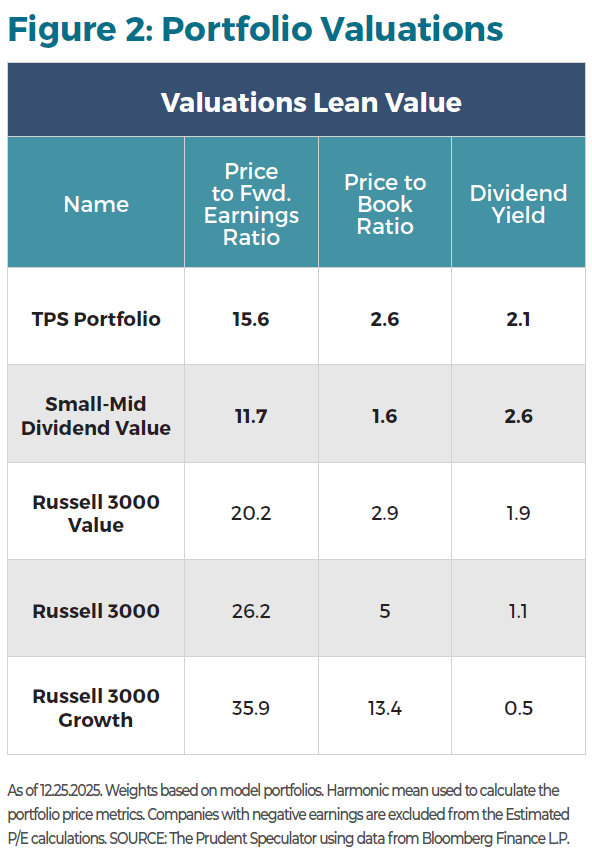
Headline valuation multiples remain elevated, as they have for some time, but multiples for our broadly diversified portfolios of stocks remain very reasonable, in our view. We offer a consolidated table of those valuations in Figure 2, though we note that our quantitative framework that analyzes more than 3,000 stocks each day and our forward-looking Target Price engine consider many more factors than the three we present below.
Even though there has been a tremendous run-up in equity prices, we believe many high-quality, dividend-paying companies trade for reasonable valuation metrics and can benefit from improving fundamentals and headwinds that may yet switch to tailwinds.
We have been glad to participate in the Tech-heavy rally this year, but we still think there’s plenty of value in owning a basket of traditional Value stocks with healthy tangible earnings, strong balance sheets, plenty of cash flow and durable competitive advantages.
A BETTER COMPASS
Knowing how 2025 played out makes it easy to talk about the benefits of staying the course. But staying the course in real time is far more difficult, especially when headlines are not built to invoke a sense of calm and often the most effective way to keep attention these days is to stoke negative emotion. That’s not great on a societal level, but we’d definitely argue that’s bad for investors. Fortunately, there are ways to avoid falling off the path to success.
First, a solid financial plan serves as a stabilizing force. As we emphasized in our June Private Client Investment Insight, a detailed plan bakes in market volatility and anticipates difficult periods. We even model worst-case scenarios for retirement spending and investment returns to ensure your path to success remains intact, even when everything feels uncertain.
Second, remember that the financial media is a business with a business model that depends on eyeballs, not smooth sailing. “Everything is fine, check back next week” doesn’t generate ad revenue. Instead, headlines swing between extremes: you’re either missing out on massive gains or dangerously exposed to looming losses that can be easily avoided with one quick trick. Almost invariably, the message is to act quickly.
We love the Lao Tzu quotation, “If you do not change direction, you may end up where you are heading,” which is why having a solid financial plan is critical. And equities, while often the lion’s share, are just one component of said plan!
Major Themes
We are often asked for one or two favored stocks, but our experience has been that it is often a pick or two way down the list that drives portfolio performance in a given year, so we always encourage folks who like our approach to buy a broad basket of undervalued names.
It’s still a market of stocks
We expect 2026 to be a year of progress, volatility and recalibration. Policy shocks, shifting expectations for interest rates, an A.I. investment boom and perhaps some gyrations in economic conditions are likely to shape the journey for equities. Even if we were negative on the prospects for America (we are very positive!), it would be counterproductive for that to make its way into our investment portfolios, as markets have time and again shown their ability to absorb surprises and grind higher over time.
The sharp selloff that followed Liberation Day was the latest reminder that headlines can move prices quickly, but fundamentals and cash flow ultimately drove longer-term returns. Investors who stayed invested through the turbulence were rewarded handsomely as conditions stabilized, valuations expanded and earnings momentum strengthened.
These dynamics are not unusual and reinforce a familiar lesson we have championed for decades. Disciplined investors with diversified portfolios of attractively valued companies tend to fare far better than those who chase trends, trade on headlines or wait endlessly for the perfect entry point. The uncertainty that feels so uncomfortable in real time often ends up being the soil in which future gains take root.
There’s a lot to like out there today. The A.I. build out is reshaping capital spending, corporate America is adjusting to a new policy regime, and the consumer continues to show underlying strength even as sentiment wavers here and there. Plenty of crosscurrents remain, but the opportunity set looks robust for patient owners of high-quality, cash-generating companies.
With that thinking in mind, we have identified seven themes we believe are likely to influence the path of our portfolios over the next twelve months and beyond. Each highlights a key feature of the investment landscape, and we offer a host of selections to consider, though we wouldn’t mind owning them all. The themes will not unfold in a straight line and perhaps some won’t pencil out right away (and history shows that some picks won’t pan out), but they offer the lens through which to navigate the road ahead and stay focused on long-term opportunity for our stock portfolios and for our clients’ and readers’ wealth as a whole.
Fond of Financials
Long staples of Value portfolios, Financial stocks have performed well in 2025, a trend we see continuing into 2026 and beyond. Citigroup (C), for example, rose by more than 50% through mid-December, substantially better than the low-teens gain for the broader S&P 500 Financials index. Trading revenue helped C and other broadly diversified financials like Bank of America (BAC) and JP Morgan Chase (JPM). That revenue can be lumpy and the ‘calm’ that generally helps investors stay on their paths to success is counterproductive for institutions who need churn. Of course, the companies we mention above make money in other ways, including banking, loans and wealth management. We like that income diversification.
Though they may fly under the radar, we like super-regional banks like Pittsburgh-based PNC Financial (PNC) or Midwest-focused Associated Banc-Corp (ASB). We like the smaller banks for their ability to be nimble and make selective acquisitions. PNC recently announced plans to purchase FirstBank Holding Co, which adds $26.8 billion in assets, plus branches in Colorado and Arizona, helping cement its status as coast-to-coast regional lender. Happily the deal is expected to be immediately accretive and doesn’t upset the well-supported 3% yield.
Make America Healthy Again?
Pharmaceutical stocks enter 2026 under the Trump administration’s Make America Healthy Again initiative, which has stated priorities of affordability and access intended through measures like the Most Favored Nation pricing framework. Recent voluntary agreements have eased uncertainty on this front, giving companies greater clarity on U.S. pricing and tariffs. For Pfizer (PFE), the resolution will likely result in some price compression, although the recent Metsera acquisition ought to accelerate its cardio-metabolic pipeline, highlighted by a robust obesity portfolio. Patent expirations also remain a challenge for the industry. Indeed, Bristol Myers Squibb (BMY) faces pressure from losses of exclusivity on its two leading drugs Eliquis and Opdivo. Management has signaled confidence in the transition period for improving momentum from newer therapies in oncology and cell therapy with multiple pivotal readouts expected in the next two years. And both Pfizer and Bristol boast single-digit P/E ratios and fat dividend yields, several times that of the S&P 500.
Another addition to our portfolios in 2025 was Novo Nordisk (NVO), which was trading hands for half price from where it ended 2024. With the GLP-1 bonanza still in the early days, we thought NVO offered exposure we didn’t have. Ozempic’s place in the market is hotly contested, especially as a weight loss treatment, and the price patients pay for the drugs has become a political lightning rod. Neither topic has been ‘settled’ in the court of public opinion or elsewhere, but we note that NVO’s core business is still diabetes care. Overall, that segment accounted for 71% of revenue in 2024, consisting of GLP-1 drugs and several types of insulin.
In addition to pharmaceuticals, we think there are other ways to benefit from awareness about health (or perhaps need for more health) in America. Among stocks we think fit nicely into this theme are fresh produce producer Fresh Del Monte (FDP) and prepared foods maker Hormel Foods (HRL), where the turkey portfolio, Planter’s snack nuts and Applegate (natural and organic meats) have been driving net sales growth. Of course, there’s health insurer Elevance (ELV), which stands to benefit from a lighter, more active populace. Indeed, that may take years or decades to fully materialize, but every bit counts, particularly as premiums are set to rise again in the near future due to changes in government support programs.
Intelligent Ways to Play A.I.
First appearing on in our Outlook several years ago, A.I. continues to be a major theme propelling the equity markets. Admittedly, it could be the only thing pushing markets higher, according to some major publications. Attribution for the S&P this year shows that’s true, with Nvidia’s 226 basis points of contribution to the S&P 500’s return through December 16th, Broadcom’s (AVGO) 113 bps and Microsoft’s (MSFT) 104 bps.
We’ve had other stellar performers, too, that have garnered fewer headlines and reflect our ‘picks and shovels’ approach to portfolio construction. They include storage drive maker Seagate Technology (STX). optical and photonic product supplier Lumentum (LITE) and fiber and glass-maker Corning (GLW).
What’s interesting about the A.I. infrastructure boom is that all the investment needs to be in place (for practical purposes) before any value can be demonstrated, so the massive build out largely is built on trust that monetization will come. Analysts have been working through that calculus with Oracle (ORCL) recently, which has tumbled as folks begin to wonder what it’s going to take for Larry Ellison & Co. to hit their financial goals and commitments. That’s not to say it won’t work. We think there are many reasons to be full-steam-ahead on the A.I. theme, but we have been thoughtful about trimming winners this year, where the risk/reward tradeoff was getting out of whack. This has included Oracle when it spiked on euphoria about massive new contract wins back in September.
Other picks-and-shovels A.I. options include power management company Eaton (ETN), data center giant Digital Realty Trust (DLR) and power generator NRG Energy (NRG). We even might argue that Target (TGT) and advertising titan Omnicom (OMC) belong in the bunch, given the potential for A.I. to make marketing dollars more potent.
Small Company, Big Potential
A reprise of the theme in previous outlooks and reflective of our emphasis on the topic in a number of Investment Insights, we think smaller companies deserve a closer look for inclusion in portfolios. We concede that small company stocks, at least when measured by the Russell 2000 index, have trailed the large company-heavy returns of the Russell 1000 or S&P 500 indexes, but that should not mean the entire universe should be ignored. In fact, we’d argue fishing in the Small Cap pond is where Value investors can find a number of potential long-term winners, while the names we like also reward investors with dividend payouts.
Among them, we like clothing retailer American Eagle Outfitters (AEO), electronics manufacturer Benchmark Electronics (BHE), oil and natural gas producer Civitas Resources (CIVI) and IT distributor Climb Global Solutions (CLMB). Homebuilder Meritage Homes (MTH) may appeal to folks who think their exposure in the southern and western parts of America can benefit from population growth, while those homeowners are likely to need appliances from Whirlpool (WHR). We also like hybrid cloud specialist NetApp (NTAP) and purveyor of square hamburgers Wendy’s (WEN).
Bargain Hunting Bonanza
We mentioned Novo Nordisk in the Health section and Civitas in the preceding Small Caps section, but bring them up again here because we think they trade substantially below fair value and have nice dividend yields that ‘pay’ shareholders while they wait for the duo to have their days in the sun. Specialty retailer Dick’s Sporting Goods (DKS), Ugg and Hoka footwear owner Decker’s Outdoor (DECK) and financial services concern U.S. Bancorp (USB) also belong in the bargain hunting section for their inexpensive valuations and upside potential.
We added Salesforce (CRM), a leader in customer relationship management, earlier this year thinking that it was being unfairly punished for A.I. advances. The thinking is that A.I. agent adoption will hamper growth prospects and take away from CRM’s large market share in the customer relationship software arena. While it seems like every company has launched some sort of A.I.-related widget, it has been a lot more difficult to find cases where companies were able to successfully monetize those tools. We don’t think that breakthroughs are in the near future for those aspiring to take a bite out of CRM’s infrastructure, making this year’s whack unfitting for the crime. CRM has a net cash position of $5+ billion and analysts expect to see annual EPS growth in the 11% to 15% range, offering a lot of upside if the A.I.-apocalypse (for CRM, anyway) fails to materialize.
Reversion to the Mean
Value investing blends growth with discipline. Our Value stocks grow too, even if their forecasts are less lofty than those at the Growth end of the spectrum, and they trade at a discount to peers or their own historical averages. That creates two paths to potential shareholder gains. First, results can exceed expectations, lifting the market price because investors become more excited about a company’s prospects. Second, valuation multiples can revert toward the norm. If a peer group trades at 15 times earnings and we own a stock at 11 times, the share price can rise simply by closing that gap, even if earnings stand still.
In that mean reversion camp, we find global automaker Volkswagen (VWAGY), brewer and alcoholic beverage producer Molson Coors (TAP) and Dutch health technology company Koninklijke Philips NV (PHG). We’d also include shippers FedEx (FDX) and United Parcel Service (UPS), with the former being focused on express and urgent shipments and the latter on ground parcels and freight.
Dividend Growers
Long-time readers and managed account clients know of our affection for dividend payments and cash flow. We wanted to highlight a series of quality companies that have raised their dividend consistently and have upside potential when it comes to our published Target Prices. Our list includes pharmaceutical and vascular product manufacturer Abbott Laboratories (ABT, 2.0%), lithium miner Albemarle (ALB, 1.2%), specialty gasses and materials producer Air Products and Chemicals (APD, 2.9%), agriculture commodities distributor Archer-Daniels-Midland (ADM, 3.5%), health products distributor Cardinal Health (CAH, 1.0%), earthmoving equipment maker Caterpillar (CAT, 1.1%) (we note that they also make A.I. data center power generation equipment too), diversified energy companies Chevron (CVX, 4.6%) and Exxon Mobil (XOM, 3.5%), defense specialist and business jet manufacturer General Dynamics (GD, 1.8%), and paper products manufacturer Kimberly Clark (KMB, 4.9%), home-improvement retailer Lowe’s (LOW, 2.0%) and medical products developer Medtronic (MDT, 2.9%).
CLOSING
Long-time readers of our outlooks will not be surprised to see that our core themes remain largely consistent from one edition to the next. That’s by design. We invest in undervalued stocks with a three-to-five-year (or longer) horizon, aiming to hold them through full business cycles. We believe the current market continues to present compelling opportunities for patient investors, as reflected in the many names highlighted throughout this report. Many of these companies also offer attractive dividend yields, providing a steady stream of income to help investors better weather the inevitable volatility that comes with equity ownership.
Naturally, success also depends on thoughtful portfolio construction. Diversification remains key, and we take this opportunity to remind readers that we offer both personalized wealth and asset management services tailored to individual needs. As we’ve said before, the true secret to long-term investing success isn’t just picking good stocks, it’s having the discipline to hold onto them. Over the years, our results have come not only from sound stock selection, but from the conviction to stay the course.
PARTNER WITH US
For more than 48 years, we have collaborated with our clients in their investment decision making process as they pursue their long-term financial goals. We are committed to keeping your goals, concerns and attitude about investing at the heart of your plan. If you’re ready to experience our personalized investment approach and exceptional client service, contact Jason R. Clark, CFA at 949.424.1013 or jclark@kovitz.com.