Markets have reacted as conflict escalates, but history favors long-term investors. On February 28, 2026, the U.S. and Israel launched large-scale airstrikes on Iranian military and government targets.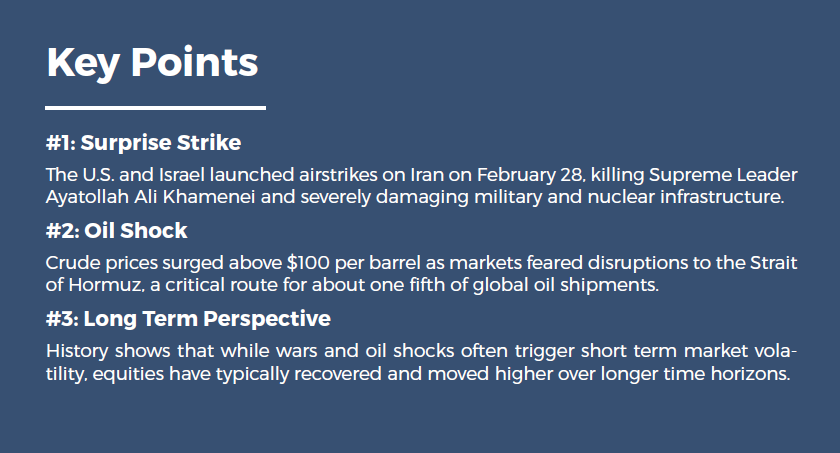

War in Iran
Markets have reacted as conflict escalates, but history favors long-term investors.
On February 28, 2026, the U.S. and Israel launched large-scale airstrikes on Iranian military and government targets. The strikes caused considerable damage and killed Iran’s Supreme Leader, Ayatollah Ali Khamenei, along with other senior officials. While President Donald Trump had warned of consequences for not negotiating, the attack marked one of the most dramatic escalations in Middle East tensions in decades. “Operation Epic Fury” targeted Iran’s missile systems, military infrastructure and facilities connected to its nuclear program.
The conflict quickly spread beyond Iran’s borders. Iranian strikes hit military bases and infrastructure in several countries including Saudi Arabia, Qatar, Bahrain and the United Arab Emirates, while fighting also intensified in Lebanon and other areas where Iranian-backed groups operate. The war has involved airstrikes, missile attacks, drone warfare and naval confrontations, including the U.S. torpedoing an Iranian frigate off the coast of Sri Lanka. Reliable sources suggest the first week-plus of fighting has resulted in more than a thousand casualties in Iran and hundreds elsewhere, with civilians among them.
Strategically, the United States and Israel have focused on destroying Iran’s missile launch systems and air defenses to weaken the country’s ability to retaliate. Iran has relied heavily on ballistic missiles and large numbers of drones to strike military bases and economic targets, including oil infrastructure. These attacks have disrupted energy markets and shipping routes in the Persian Gulf, raising fears of a wider regional war and driving volatility in global oil prices.
The political situation inside Iran has also shifted. After the death of Ayatollah Ali Khamenei, Iran’s leadership structure moved quickly to install Mojtaba Khamenei as the third supreme leader of Iran, taking over for his father. It’s impossible to say what the ultimate outcome will be, but the Financial Times argued, “[the choice] is a move that signals the Islamic republic is likely to maintain its hardline policies towards the US, Israel and the West.” Geopolitical analysts warn that the war could become prolonged because Iran’s political system and military networks are deeply entrenched, making rapid regime change unlikely even under sustained military pressure.
MARKET REACTIONS
Not surprisingly, financial markets gyrated wildly, with equities selling off and rebounding over the first couple days of the conflict, but hopes for a quick conclusion to the hostilities dissipated as Tehran responded to President Trump’s demands by saying, “Iran’s enemies must take their dream of the Iranian people’s unconditional surrender to their graves.”
With energy prices soaring as the second week of March began (see Figure 1), U.S. stocks came under significant pressure as investors contended with a virtually unprecedented spike in crude because the fighting threatens the Strait of Hormuz, a shipping route that sees about one-fifth of the world’s oil transit through. Brent crude and West Texas Intermediate both surged above $100 a barrel, with some prints near $120. Some warned that if the strait were significantly disrupted for a prolonged period of time, oil prices could climb to $150 or more.
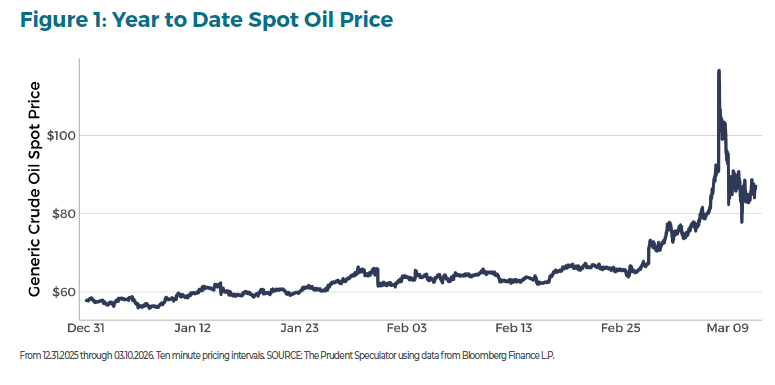
Of course, no sooner had one prominent market pundit declared, “I don’t see a path to de-escalation,” President Trump said the war will be over “very soon” (but not in the next week) and that the conflict is “very complete, pretty much.” He argued that there was “nothing left” in Iran in a military sense. He told the press, “We could call it a tremendous success now and leave here…or we could go further, and we’re going to go further.” It’s hard to say what going “further” means, but energy markets seemed to breathe a sigh of relief with March 2026 Brent Crude contracts dropping below $90 and near $70 for December contracts. WTI prices dropped similarly.
Despite President Trump’s statements, the action was still not over on March 10, with heavy bombardment of Tehran and other targets overnight. U.S. defense secretary Pete Hegseth proclaimed it would be the “most intense day of strikes inside Iran,” while Benjamin Netanyahu said Israel’s campaign is “not done yet.” And Saudi Aramco, the state-owned oil giant, warned of “catastrophic consequences” for the global economy if the war continues.
Needless to say, there are still more than a few acts left in this Middle Eastern drama!
TPS EXPOSURE
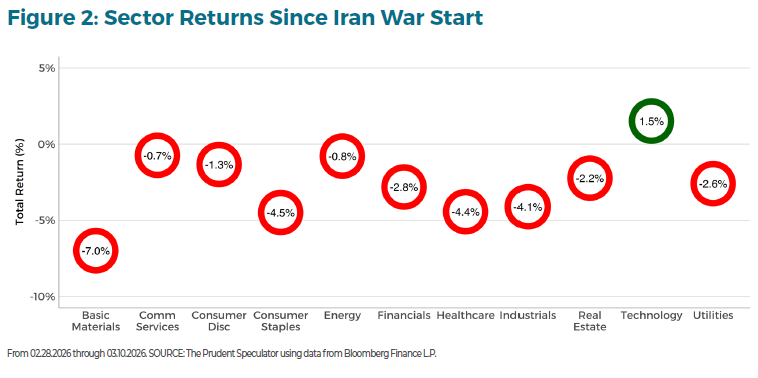
Certainly, the Middle East was not the only factor impacting equities as mixed economic data, private credit worries and a pullback in A.I.-related stocks influenced prices. Within equities, sector performance diverged sharply. Energy producers and upstream oil companies rallied because higher crude prices improve profits. SM Energy (SM) and HF Sinclair (DINO) both gained more than 7%, while EOG Resources (EOG) and Devon Energy (DVN) posted more modest gains. Global oil majors like Chevron (CVX), Exxon (XOM) and TotalEnergies (TTE) dipped as the war unfolded, with higher prices evidently offset by concerns about oil movement.
Canadian fertilizer outfit Nutrien (NTR) gained slightly, while Mosaic (MOS) dropped in the first week-plus of the conflict. The Strait of Hormuz is a chokepoint for fertilizer inputs, including nitrogen, phosphate and ammonia, and the effective closing of the transit lane by the Iranian Revolutionary Guard has caused urea prices to surge.
International insurers like Allianz (ALIZY) and AXA (AXAHY) struggled, with both plunging nearly 10% as foreign markets were hit much harder than those here at home and transit risks rose. The large drop for our low-beta insurance stocks was somewhat confounding given that travel policies like those offered by Allianz generally exclude war as a covered claim.
Sectors that depend heavily on fuel or economic growth sold off, including the airlines, package transporters like FedEx (FDX) and United Parcel Service (UPS), homebuilder Meritage Homes (MTH) and appliance-maker Whirlpool (WHR). Retailers American Eagle (AEO), Abercrombie (ANF) and Deckers Outdoor (DECK) also sank during the frenzy on worries about consumer spending and supply-chain disruptions.
While defense stocks like Lockheed (LMT) and General Dynamics (GD) had advanced prior to the conflict (the iShares U.S. Aerospace & Defense ETF gained 47% in 2025 benefiting from expectations of a more dangerous world), the immediate market reaction to the actual outbreak of hostilities was sharply positive, with LMT surging 6.7% in premarket trading on March 2. After the initial rally, defense stocks experienced some volatility on March 3, though they remained relatively resilient even as broader markets sold off on concerns about a prolonged conflict.
Investor focus has since shifted to the scale and duration of military engagement, with implications for weapons replenishment and defense budgets.
Outside the U.S., markets reacted even more violently. Several Asian markets dropped sharply, with South Korea’s Kospi skidding more than 18% over March 3-4, before rebounding nearly 10% on March 5. Technology giants at home and abroad, as well as export-driven companies, were hit particularly hard because they rely on stable energy supplies and global trade. At the same time, traditional ‘safe havens’ such as gold rose as investors sought protection from geopolitical and inflation risk.
PRICE SHOCKS
History shows that oil shocks tied to geopolitical conflict rarely derail the stock market for long. Figure 3 highlights the major energy spikes over the past fifty years. In three of the four historical cases, the S&P 500 rallied after oil peaked (we shall see if March 9 proves to be the high this go round), with the index posting an average gain of 7%. Investors seem to react to the shock itself with caution but stocks eventually have stabilized and moved higher over time.
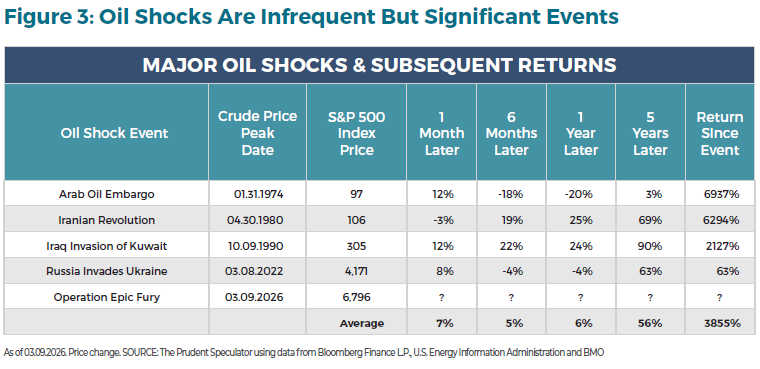
The intermediate-term picture is mixed. Six months and one year after the oil shock, the average return is positive, but there is wide dispersion. These periods often coincide with slower economic growth or tightening financial conditions triggered by higher energy costs. The Arab oil embargo that began in 1973 and the Russian invasion of Ukraine in 2022 are good examples where energy shocks contributed to broad economic stress.
Longer term results tell a very different story. Five years after each event the S&P 500 produced strong gains, averaging 56% (see table), which would be much greater with dividends included. Even the most disruptive geopolitical events eventually gave way to economic recovery, corporate earnings growth and rising equity prices. Investors who remained focused on the long term were rewarded despite the volatility that followed the initial oil shock.
While oil spikes tied to geopolitical conflict can create short term stress and market volatility, history suggests they rarely alter the long term trajectory of equities. With the S&P 500 at 6,796 at the onset of Operation Epic Fury, versus 97 back in 1974, past episodes suggest investors should focus less on the shock and more on the broader economic and earnings outlook in the years ahead.
WARS & CONFLICTS
In Figure 4, we review major U.S. military actions in the Middle East since 1980 and the subsequent performance of the S&P 500. Historically, the market’s immediate reaction has been tame, declining about 1% in the month following, reflecting short term uncertainty.
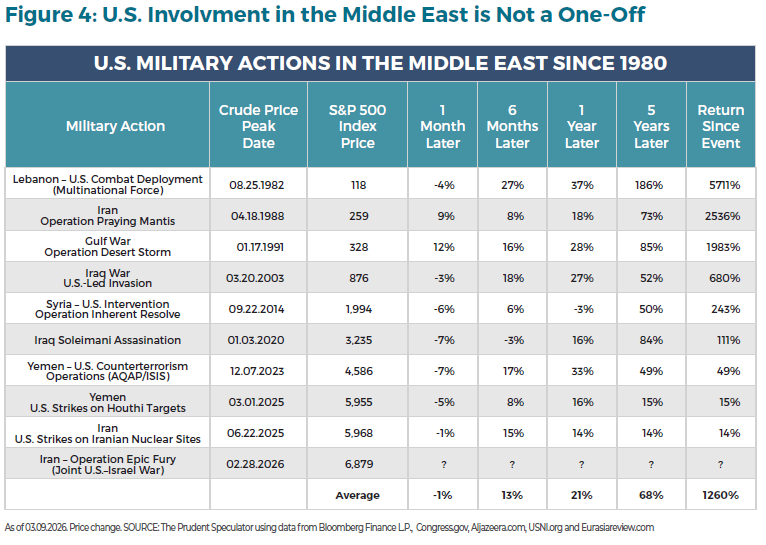
Performance improves over time. Six months after the military action, the S&P 500 gained an average of 13%, and one year later the average advance reached 21%, with those tallies well above the historical norm. While conflicts can create temporary volatility, economic fundamentals and corporate earnings have bounced back.
Longer-term results are especially strong. Five years after these military actions, the S&P 500 posted an average gain of roughly 68%. Time will tell the impact of Operation Epic Fury in February 2026, but history suggests geopolitical shocks (and just about anything else for the matter) rarely derail the market’s long term uptrend.
STAY THE COURSE
Obviously, the war in Iran is tragic on many levels. The loss of life and the risk of a broader regional conflict underscore the seriousness of the situation, particularly as tensions extend across the Middle East. By no means do we want to diminish the human suffering and we know that conditions could become much worse (or dare we say better?) in the near term.
However, our task is always to stay on an even keel, especially in the age of not-so-unbiased 24/7 news and social media postings. We understand that emotions can run high, so our writings remain centered on the long term prospects for equities in general and our portfolios in particular.
History is always a guide and never the gospel, but we find that it affords much more peaceful slumber to study the past as it offers important reminders that stocks have endured wars, crises, shocks and numerous other events, yet over time the markets have always moved higher.