Everything You Need to Know About Diversification

Everything You Need to Know About Diversification
By spreading exposure across a wide variety of assets that react differently to economic shifts, investors can create portfolios built not just to grow, but to endure.
Diversification is one of the most effective tools for achieving long-term investment success. It does not remove risk entirely but spreads exposure across a range of assets and opportunities. By holding investments that respond differently to prevailing economic and market conditions, investors can reduce large swings in portfolio value, maintain discipline during volatility and keep their financial plans on course.
History reminds us that markets move in cycles. Leadership changes, sectors rotate, technology advances and trends reverse. Concentrated portfolios often shine for a time, then falter when winds change. Diversified portfolios, by contrast, are constructed to remain resilient through changing conditions, capturing returns from multiple sources and limiting the damage from any single risk factor. Over the long run, this balance supports steadier portfolio growth and helps investors stay focused on their objectives.
We view diversification as both a quantitative process and a behavioral safeguard. It combines different types of assets, sectors, businesses and valuation approaches to achieve stability and opportunity. Value stocks (companies that trade at lower valuations based on measures such as earnings, book value, dividends or cash flow) remain our central focus because they have historically offered a combination of income, growth potential and downside protection. Their tendency to rebound after periods of neglect often enhances long-term returns and strengthens overall portfolio mix.
Stocks remain the primary vehicle through which we pursue value opportunities, yet in recent years we have broadened our approach (and our team!) to build more comprehensive asset allocations that align with each investor’s personal financial objectives. The goal remains the same: build portfolios designed to endure and prosper through a wide range of market environments.
This paper examines how diversification functions in practice and why Value investing deserves emphasis within it. It discusses the interaction between asset allocation, market behavior and investor discipline. It also studies the ownership of a varying number of differentiated assets within a portfolio, supporting the ultimate goal of helping one reach their objectives.
FOUNDATIONS OF DIVERSIFICATION
The idea behind diversification is as old as investing itself: do not put all your eggs in one basket. The phrase sounds elementary, yet it captures one of the most important truths in the finance world. Every investment involves some level of uncertainty. By purposefully spreading capital across different companies, industries and asset classes, investors can reduce the effect of any single setback. A well-diversified portfolio may not always produce the highest short-term gains, but it generally provides steadier and more durable results over time. To use a baseball analogy, we would prefer to hit singles and doubles consistently instead of an infrequent grand slam. Happily, our experience over the last nearly 50 years has been that the effort to hit singles and doubles sometimes includes a grand slam!
The academic foundation for this principle was established by Harry Markowitz in 1952 through the creation of Modern Portfolio Theory (MPT). Dr. Markowitz’s research showed that a portfolio’s overall risk is not simply the sum of its parts. The crucial factor is how those parts interact. When assets have low or negative correlations, meaning they do not move in alignment, the total volatility of the portfolio can decline even if individual holdings remain risky. This concept transformed investing from an exercise in individual stock selection to one of thoughtful portfolio-building.
Several key measures help investors put diversification into practice. Correlation coefficients indicate how two assets move in relation to each other, ranging from +1 for perfect alignment to -1 for complete opposition. Standard deviation measures how widely returns vary from the average, offering a view of overall volatility. The Sharpe Ratio evaluates how much excess return (asset return less risk-free return) is earned for each unit of risk, showing which portfolios achieve the most efficient balance between reward and risk.
Diversification also serves a powerful behavioral purpose. Markets are unpredictable, and even the most seasoned investors cannot forecast every turn, try as they might. A thoughtfully-diversified portfolio reduces the temptation to react emotionally to short-term volatility, helping investors remain focused on their long-term goals. By limiting the impact of large losses and preventing overexposure to any single theme or security, diversification supports discipline and consistency, critical parts of investing success.
Today, diversification extends across multiple, perhaps even limitless, dimensions. Investors can diversify by asset class, industry, company size or geography. They may also choose to use style factors such as Value, Growth, momentum or quality. These exposures rarely trend in unison, which is precisely the point. Broad diversification ensures that portfolios participate in many areas of opportunity while avoiding the full brunt of inevitable downturns.
Within equities, Value stocks play a distinctive role in our effort to diversify our portfolios. Their performance patterns often differ from those of growth-oriented companies (though both Value and Growth stocks have risen over long periods of time), offering balance when market sentiment shifts. Historically, Value stocks have shown strength during periods of rising interest rates or inflation, while also sporting lower risk, measured by rolling three-year standard deviation.
Although our work to build asset allocations using personalized financial plans as foundations is a more recent development (since 2018), diversification has been part of the Al Frank Way for nearly half a century. It first appeared in Issue #11 of The Prudent Speculator, published in July 1977, and has remained an investing cornerstone ever since. Now past our 700th issue, we continue to stress that diversification is not about owning a little of everything, but about thoughtful portfolio construction.
In Edition #155 on April 30, 1983, editor and TPS founder Al Frank wrote: Another metaphysical principle might be that of diversity. Many wise and successful speculators have said to take only a few positions and watch them carefully.
My “first principle” on this subject is to take many well-selected positions and hardly watch them at all! It may be that benign neglect has made more money for shareholders than any other operating methodology. True, there is the occasional stock that goes down the tubes, but that experience is more often matched and overcome by the stocks that continue to advance in price to unexpectedly high price levels.
Six years ago, Zayre was a struggling discounter apparently on the verge of bankruptcy, trading for $10 per share. One share of Zayre then is now four shares trading around $45 each, a 1,600% long-term capital gain, and still recommended by many advisory services. Meanwhile, a few others did go under, like Grant’s. Yet an equal-dollar stock position in both Grant’s and Zayre would have resulted in an excellent long-term capital gain, even with one of them a total loss!
Understanding the roots of diversification provides the groundwork for exploring how Value investing fits within this framework. Together, they form a disciplined approach that seeks both protection and opportunity.
STATMAN & SHEFRIN
In June 2000, Dr. Meir Statman and Dr. Hersh Shefrin, both of of Santa Clara University, introduced Behavioral Portfolio Theory (BPT) in the Journal of Financial and Quantitative Analysis. The paper proposed that investors construct portfolios not solely for maximum return per unit of risk (as in Markowitz’s mean-variance theory) but based on broader human motivations such as security, aspiration and the probability of achieving desired wealth levels.
Under Behavioral Portfolio Theory, investors are driven by two competing goals. First is the desire for downside protection. Second is the pursuit of upside potential. Rather than holding one optimized portfolio, investors often organize their holdings into mental accounts, creating layers that serve different emotional or financial needs. The result resembles a pyramid, where lower layers emphasize safety (bonds, cash, stable assets) and upper layers aim for wealth accumulation or “a shot at riches” (stocks, options, alternatives, highly speculative positions).
Statman and Shefrin contrasted this framework with the Capital Asset Pricing Model (CAPM) and mean-variance optimization, noting that the efficient frontiers differ. Investors guided by BPT may hold portfolios that combine safe assets and risky “lottery-like” positions, which traditional theory would deem inefficient but which align with observed real-world behavior.
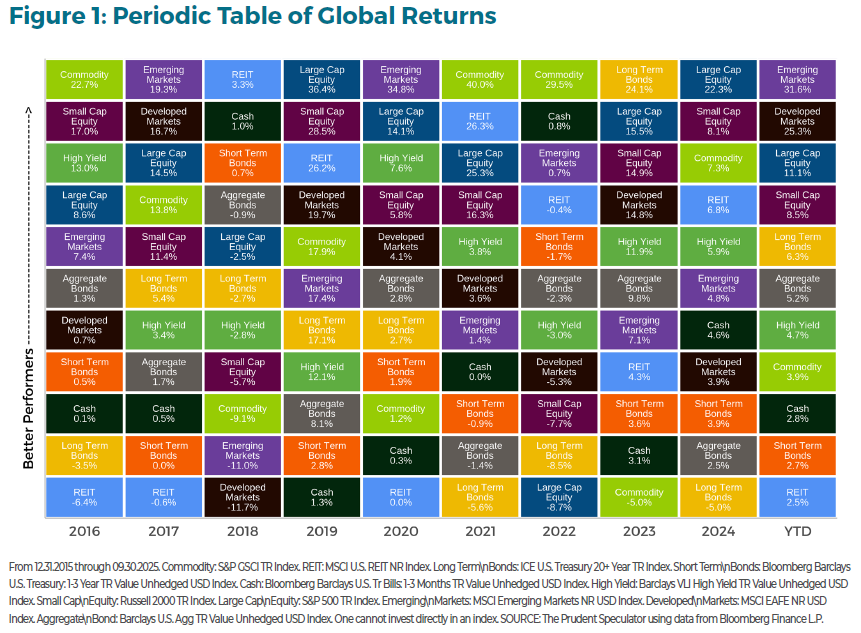
Two years later, in his 2002 paper “How Much Diversification is Enough?”, Dr. Statman revisited the topic. He reaffirmed that mean-variance optimization suggests investors should hold more than 120 stocks for adequate diversification. However, most investors (at the time) held far fewer, typically just a handful. Statman explained this through BPT: investors mentally separate their portfolios into a well-diversified “core” for stability and a less diversified “satellite” for potential upside. This “core and satellite” approach reflects both rational diversification and behavioral preference.
Statman cautioned that investors must draw a clear line between downside protection and upside pursuit so that “dreams of riches do not plunge investors into poverty.” While BPT accepts that some investors will take concentrated risks for potential gain, it emphasizes the importance of maintaining a solid, diversified foundation beneath those risks.
CAMPBELL ET AL.
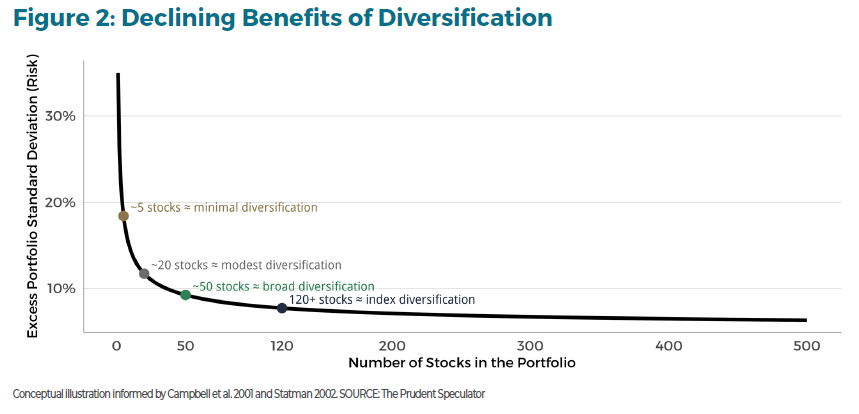
In 2001, John Campbell of Harvard University, along with his co-authors, analyzed data from the Center for Research in Security Prices (CRSP) for the 1986–1997 period and found that the benefits of diversification had increased over time. Their study showed that a 50-stock portfolio in the 1990s achieved the same reduction in excess standard deviation that a 20-stock portfolio had provided between 1963 and 1985. They also observed that portfolios concentrated in only a few securities experienced steadily rising levels of risk from the 1960s through the 1990s, while broadly diversified portfolios saw only modest increases in overall volatility.
Dr. Campbell cautioned that assuming a 20- or 30-stock portfolio always provides full diversification may be misleading. He noted in his paper, “Conventional wisdom holds that such a portfolio closely approximates a well-diversified portfolio in which all idiosyncratic risk is eliminated. However, the adequacy of this approximation depends on the level of idiosyncratic volatility in the stocks making up the portfolio.”
Dr. Statman offered a counterpoint through his own analysis. He found that expanding diversification beyond 30 holdings can still provide meaningful benefit. Using data from the Vanguard Index 500 Fund, which mirrors the S&P 500, Statman calculated that the index fund outperformed a 30-stock portfolio by an annual margin of 0.52%, representing a modest net advantage even after accounting for the fund’s 0.49% annual expense ratio.
THE TPS METHOD
Our approach begins with a foundation in broad equity diversification. We typically hold between 70 and 90 individual stocks, more than the concentrated portfolios studied by Campbell and more manageable than buying the 500 stocks Statman suggests. We believe the 70-90 stock range gives our portfolios a level of breadth that provides meaningful participation across the market while keeping any single company’s influence modest. The goal is not to avoid volatility entirely but to prevent one poor performer or sector from derailing long-term results.
Perhaps interestingly, few of our largest historical winners were not research team ‘favorites’. For example, we first recommended Apple in October 2000 and it was hardly the juggernaut it is today. It had a good balance sheet and reasonable valuation metrics (1x price-to-sales), but it was losing money and CEO Steve Jobs was struggling to right the ship. On October 6, 2000 we bought our first tranche and it promptly fell 30% over the ensuing few months. Not great!
A little more than a year later, the share price had risen, but things were still not well. We wrote in a Hotline: Apple CEO Steve Jobs commented, “Like others in our industry, we are experiencing a slowdown in sales this quarter. As a result, we’re going to miss our revenue projections by around 10%, resulting in slightly lower profits. We’ve got some amazing new products in development, so we’re excited about the year ahead. As one of the few companies currently making a profit in the PC business, we remain very optimistic about Apple’s prospects for long-term growth.” Our revised buy limit for AAPL is $16.56 as the company trades for just one times sales while maintaining a pristine balance sheet containing little debt and cash and short-term investments of some $12 per share.
From a marketing perspective, it’d be wonderful to tout that Apple was our top pick of 2000 and have held it ever since. After all, the latter is true and it is up 78,000% including dividends. But the reality is that there was no way for us to know that Apple was going to be a star, thereby deserving an outsized weight, while the E.W. Blanch shares we bought around the same time would lose 28% before that reinsurance company was bought out six months later.
We find value in our Value style emphasis and thoughtful approach to position-level diversification. We are Value investors at our core, but within that discipline, we seek a wide array of opportunities. While equities remain the foundation for long-term wealth creation, we recognize the complementary role of fixed income and cash equivalents, particularly for clients with shorter time horizons or income needs. These holdings are not meant to replace equity exposure but to moderate risk, generate cash flow and help investors maintain discipline during downturns.
To illustrate the value of diversification, we conducted a large-scale simulation to examine how portfolio size affects investment outcomes within the Russell 3000 universe from 2014 through 2024. Each year, we generated 100,000 simulated portfolios holding 5, 10, 50, or 100 randomly selected stocks. To ensure comparability, each stock was required to have a full year of return data (something that would be challenging in real time since corporate actions are not known in advance) and portfolio holdings were reshuffled annually. The overall portfolio return represents the monthly average return of the 100,000 simulations, compounded across the full analysis period.
Figure 3 highlights the differences among portfolios of varying size in terms of return per unit of risk (total return divided by standard deviation). Standard deviation reflects the degree of movement around the average. A higher return per unit of risk indicates a more efficient balance between reward and volatility.
Portfolios with fewer stocks produced decent average returns (8.1% for 5-stock portfolios and 6.9% for 10-stock portfolios) but with far greater dispersion of outcomes. The standard deviation for a 5-stock portfolio was 24.8, compared with 23.8 for a 10-stock portfolio. Adding diversification reduced volatility further. A 50-stock portfolio had a standard deviation of 23.4, while a 100-stock portfolio dropped to 21.1. Returns also improved with diversification. The 50-stock portfolio averaged 9.3%, and the 100-stock portfolio 9.9%. For reference, the
Russell 1000 Equal Weight index returned 8.8% over the same period, and the Russell 2000 Equal Weight index returned 6.0%.
The portfolio simulation results show that portfolios with fewer holdings offered a chance for higher returns but that came at the expense of much higher variability, which is a tradeoff that’s not suitable for many investors. In contrast, larger, more diversified portfolios experienced steadier performance and had better efficiency on a risk-adjusted basis. While we believe the results strongly support the case for broad diversification, they do not point to a single “correct” number of holdings. Striking the right balance depends on each investor’s goals, risk tolerance and time horizon.
ASSET CLASS DIVERSIFICATION
Given that we are Value-stock owners at heart (and have been since 1977!), we focus a lot on the diversification of our stock portfolios, which generally are comprised of 70-90 positions. However, we believe it’s worth taking a step up the ladder to diversification at the asset class level. Asset class buckets are much more broad, usually using four main categories: Equities, Fixed Income, Real Estate and Alternatives/Other. Academic research has shown that the division between stocks, bonds and other assets explains the majority of portfolio performance over time.
A landmark study by Brinson, Hood and Beebower (1986) found that asset allocation, rather than individual security selection or market timing, accounts for more than 90% of a portfolio’s return variability. It is an important reminder that the wrong allocation to an exposure can knock an investor off the pathway to their long-term personal financial goals.
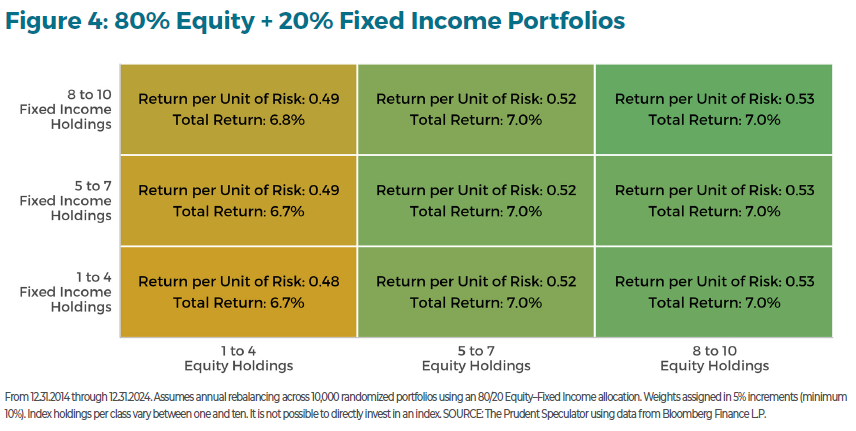
The simulation shown in Figure 4 examined the effects of diversification by constructing portfolios across three allocation scenarios, focusing on an 80% Equity and 20% Fixed Income mix. We used index data from 2014 to 2024 covering what we beieve is a wide set of potential exposures, including global equities (such as Developed Markets, Emerging Markets), domestic indexes (large-cap S&P 500, small-cap Russell 2000), global bonds (global aggregate bonds, Emerging Market high-yield) and domestic bonds (short-term Treasuries, long-term Corporates). In all, the simulation chose from 81 equity and fixed income broad market indexes to build the portfolios.
Within each asset class, the number of underlying indexes was allowed to vary randomly between one and ten, with weights assigned in 5% increments and a minimum allocation of 10% to ensure that each position contributed meaningfully to overall portfolio exposure. The total exposure for each asset class was then scaled proportionally to the target allocation, creating realistic variations in composition. Portfolios were rebalanced annually, and the process was repeated 10,000 times to capture a wide range of potential outcomes. For every simulation, we calculated total return, volatility and return-to-risk ratios, then organized results into buckets of 1-4, 5-7, and 8-10 holdings per asset class to evaluate how expanding the number of holdings influences performance and risk characteristics.
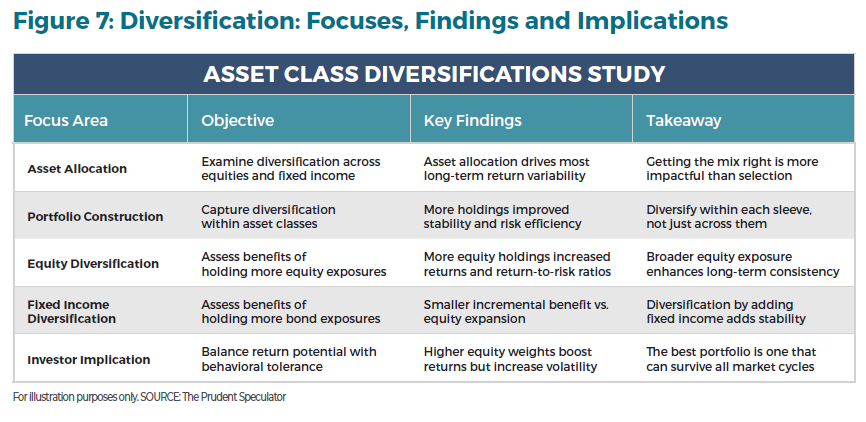
Figure 4 presents the results for the 80% Equity + 20% Fixed Income case. The findings illustrate that investors generally benefit from broader diversification within equities, with the simulated portfolios holding a larger number of equity indexes displaying higher return-to-risk efficiency and a smoother performance profile. The relationship is slightly less pronounced within fixed income, where adding additional holdings yields smaller incremental benefits, although there is still a modest improvement in average returns and overall portfolio consistency. Collectively, the analysis reinforces the message that there is value in maintaining diversified exposures across asset classes and within each component of an investor’s portfolio.
In Figures 5 and 6, we adjusted the analysis by reducing equity weights and reallocating the difference to the fixed income allocation, offering insight for investors with more conservative profiles looking to steady the ride. The results were consistent across scenarios. Expanding diversification within the available equity options meaningfully improved return per unit of risk characteristics, while additional fixed income diversification had a more limited impact.
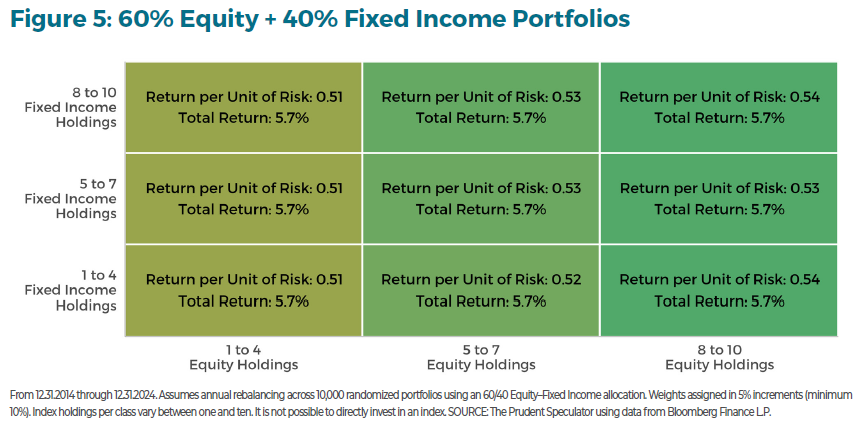
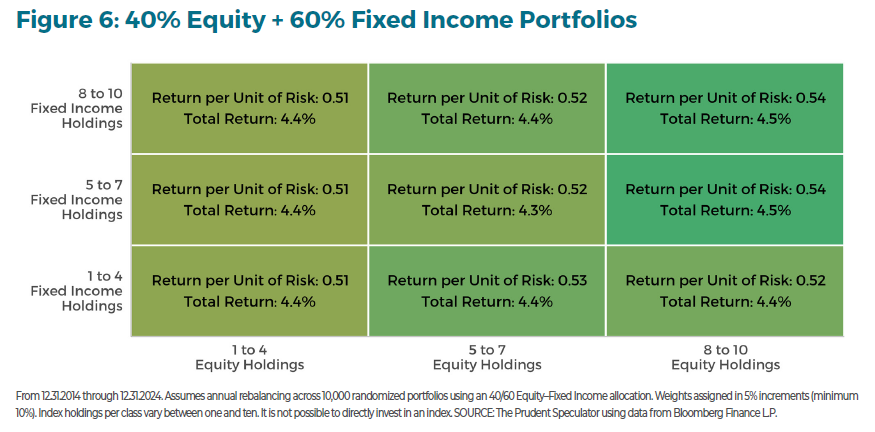
Academic research and our own number-crunching show that asset allocation is a significant determinant of portfolio outcomes. However, as Figures 3 through 6 demonstrate, simply having an asset allocation portfolio is insufficient. True diversification requires careful construction rather than simply spreading capital across a few broad categories.
Another key takeaway is that portfolios with larger equity allocations tended to produce higher average returns. This outcome is probably intuitive, as equities have historically outperformed bonds over longer time periods. The trade-off is that equities also exhibit greater volatility.
To capture their long-term advantage, investors must be willing (and able) to endure the inevitable market fluctuations along the way. In practice, we often find that a 100% Equity allocation could generate the strongest results over several decades, yet the sharp drawdowns that occur periodically (such as a 10% pullback in a given year or a 20% decline every few years) may prompt emotional selling or portfolio shuffling at precisely the wrong time.
As a result, the most effective portfolio is not necessarily the one with the highest expected return, but the one an investor can stick with through full market cycles. Selecting an appropriate equity weight is therefore as much a matter of behavioral discipline as it is of numerical optimization and calculus.
OTHER WAYS TO DIVERSIFY
Within asset classes, particularly equities, style diversification offers a finer level of control. Academic research, including the multi-factor work of Eugene Fama and Kenneth French, highlights that distinct equity styles such as Value, Growth, Quality, Geography and Size (small- vs. large-cap) represent different sources of return. Each style performs best under certain economic and market conditions, which means that holding a mix can smooth results through full cycles.
The risk of style concentration has become more visible in recent years, particularly through the dominance of a handful of mega-cap Growth stocks. Portfolios heavily weighted toward these companies can experience elevated volatility and greater downside when sentiment turns. Style diversification guards against this by balancing exposure between cyclical and defensive areas, high-growth and income-generating holdings, and large and smaller capitalization stocks.
CONSTRUCTING AN ALLOCATION
Constructing an asset allocation is one of the most consequential decisions an investor makes. It requires balancing the overall asset class mix, determining how many exposures to hold and selecting the specific funds or vehicles that best represent them. Equally important, investors must confirm that the underlying portfolios provide sufficient diversification and align with their objectives, time horizon and risk tolerance.
Emotion = Risk
Diversification is as much about temperament as it is about returns.
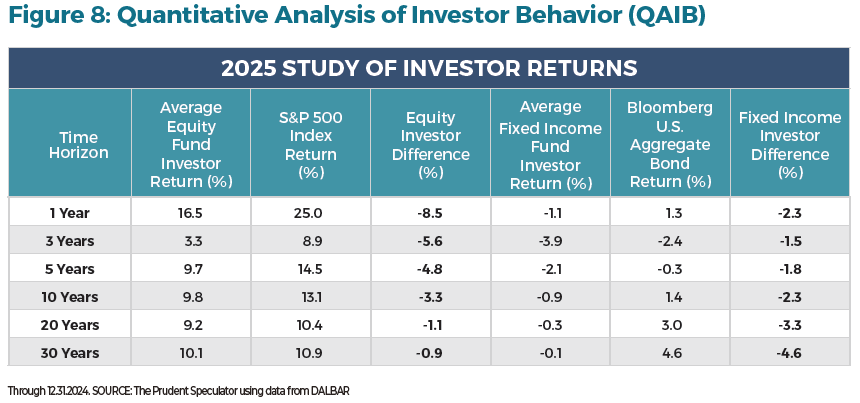
Successful investing isn’t just about numbers, it’s about behavior. Even the soundest asset allocation can be undone by emotions. Unfortunately, investors are often their own worst enemies, prone to selling in fear during downturns and chasing returns during rallies (Figure 8). Diversification, while often discussed in context of the trade-off between returns and risk, carries another powerful benefit. It helps investors stay disciplined when markets drop and test resolve.
Portfolios holding a mix of assets, including stocks and bonds, are designed to dampen large swings in portfolio value. That steadier ride matters. By smoothing volatility, diversification reduces the emotional peaks and valleys that often lead to poor decisions. History is filled with examples of investors who fled to the safety of cash during a period of market tumult, only to miss the recovery because they were waiting on the sidelines.
In our experience, investors with balanced, diversified portfolios spend less time worrying about market fluctuations and more time staying focused on their long-term goals.
BROAD MARKET RISKS
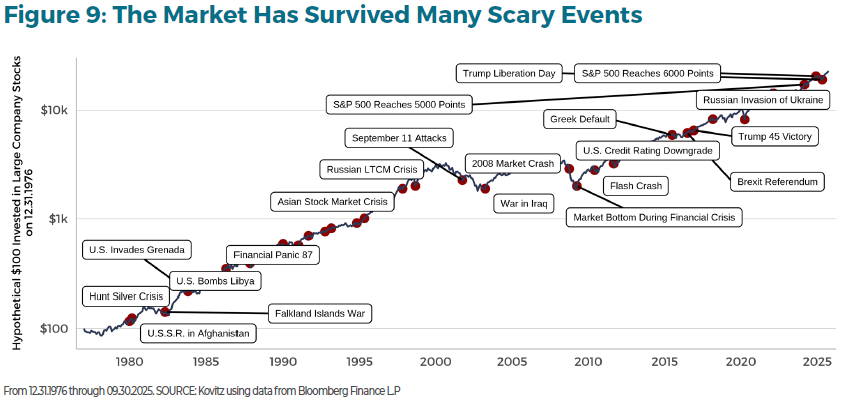
Since our first issue, we’ve navigated eight official Bear Markets and countless shocks, including wars, recessions and crises, many of which are shown in Figure 9. History’s verdict is clear: market turbulence is unavoidable, but staying invested through it is one of the keys to success.
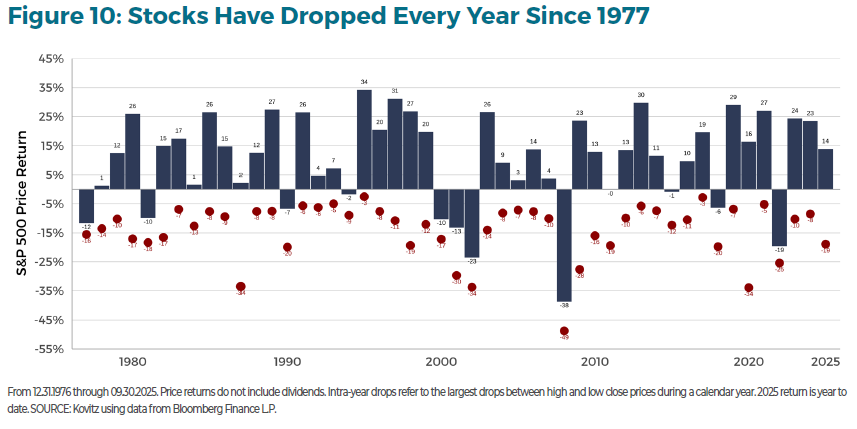
Many of the market’s best days arrive near its worst. Investors who sell during downturns risk missing the powerful early stages of recovery, when returns are often strongest. As Figure 10 highlights, the market has experienced a peak-to-trough decline every year since 1977, yet stocks have still returned roughly 12% per year.
Most investors own equities for their growth and income potential, but market pullbacks can test both determination and patience. One of the key reasons to broadly diversify is to bring greater stability to one’s investment journey while keeping long-term goals on track.
Decades of Diversification
“Diversification spreads risk, but Value defines the reward…Diversification through Value has historically driven wealth creation.”
Diversification isn’t top of mind for many investors today. With $0 trading costs and an endless stream of market commentary, it’s easy to focus on what’s been working, most notably the “Magnificent Seven” and a few other dominant names that have powered much of the market’s advance over the past decade. After such a long run of outperformance, concern about how those companies might fare in the future is far lower than it should be.
In our nearly 50 years of investment experience (far more when counting the collective wisdom of our team), we’ve been to this show before. Letting winners ride while skipping diversification can feel comfortable during the good times, but when declines arrive, they tend to be sharper and jarring. Indeed, the worst ones can knock you off of your path to financial success. That’s why we continue to emphasize that diversification is a cornerstone of a sound investment strategy and it goes a long way in supporting a personal financial plan. It provides a personalized framework for enduring the inevitable ups and downs that come with equity ownership.
In this section, we revisit the perspective of The Prudent Speculator founder Al Frank and current Editor John Buckingham, both of whom have long championed patience, selection and diversification as essential portfolio ingredients.
In August 1980, Al reflected:
Perhaps we had a “correction” during the past fortnight? In observing the “New York Stock Exchange Diary” on Page Two, one finds that for five trading sessions the Average Price per Share of Common stock, closely tied to the Composite Index, declined. It turns out that the total amount of decline, 41 cents, was more than compensated for on the 7th’s gain of 47 cents, but that is merely an example of how the market fluctuates on average. All through the fortnight the new highs versus the new lows ratio has been bullish, and when it faded for a day (on 7/31) from its classic 9-to-1 bull-market ratio, it came back the next day and built an even stronger case during the next week. So, even when the market looks “toppy” and in a rotational correction phase, especially during last Friday’s early morning panic buying and late afternoon sell off, the 231 new highs to one new low suggests considerable internal strength, as does the large trading volume.
In 1985, Al wrote an essay about his diversification work, part of which we reprise here:
Diversification, DIVERSIFICATION, as a stock market parallel to the location theme in real estate. I realized that the thesis of diversification would be less meaningful if not tied to patience and selectivity, not unlike working with a one-legged stool. If one absolutely knew the exact times to buy (or sell) any given stock or stock market, then one would not need any diversification. Since both selection and timing (or patience) are imperfect arts, they can be helped immensely by a strategy of diversification.
For example, we know that stock markets can be oversold and thus due for an advance for an extended time period. That is, oversold stock markets can become even more oversold as they continue to decline on average, and then can stay oversold in a “trading range” for an extended period. But they can also explode to the upside at any time. Likewise, overbought markets, that “should” decline, can become more overbought as they advance to irrational levels.
Complicating market timing calls, a dubious endeavor except at extremes, is individual stock timing. Stocks can become more undervalued or more overvalued independently of what their markets are doing. Perhaps a majority of stocks react to the primary trend of the market, but they do not do so uniformly, so that at any given time some may be topping out or bottoming out before or after the market-wide averages follow suit. This phenomenon is sometimes referred to as group rotation, or a split market, wherein so-called blue chip stocks are registering movements contrary to the second- or third-tier stocks.
Diversification helps to cope with this stocks versus markets “problem.” As one finds new bargains, one can do the equivalent of dollar-cost averaging, or averaging down, in anticipation of both an upward revaluation of stocks and a potential market-wide advance.
In 1987, Al coined us “Diversificationists”:
We are diversificationists. We believe in diversified portfolios, and try to have at least 15 stocks and preferably 30 or more positions. We know that our judgments do not work out 20% or more of the time and we do not want to be hurt by the stocks that fail. Stocks that have been absolute disasters and that have driven some investors into great losses, need not do much harm to the portfolio which is limited to 5% positions in them. A complete loss, which is quite rare, or a 50% loss, which is quite common, only leads to a percent or two loss for the widely diversified portfolio. These losses, even when they happen to half the stocks in the portfolio over the short run are usually overcome by the gains of the other half of the portfolio. As the simple truism goes, you can only lose the cost of a position (and rarely that), but you can gain many times the cost of a position.
Al passed away in 2002 and John Buckingham (who had long been Al’s right-hand person) took the torch as Editor. In early 2003, John wrote:
Quick profits from buyouts are nice, but our founder Al Frank always invested for the long-term, partnering with the companies he owned. Al’s success was based on patiently buying and holding a broadly diversified portfolio of undervalued stocks. The stellar performance of our portfolios during April again illustrates the merits of our time-tested approach. Buffett may turn out to be right about future market returns, but I believe that followers of the Al Frank philosophy will continue to beat the market, just as they have for the past 26 years.
And later in 2003, John noted:
I want to remind our subscribers how important portfolio diversification is to the success of our stock selection process. That success comes from our overall batting average rather than from a few home runs. Which is why we have a minimum of 25 stocks in each of our recommended portfolios. For bigger portfolios, we suggest even broader diversification. With that many holdings, as history shows, the losers and the laggards are easily absorbed. For us, there is not only safety in numbers, there is success in numbers.
WHY BOTHER WITH STOCKS?
We are sometimes asked, “If diversification is the secret sauce, then why worry about Value stocks relative to other investment options?”
As we’ve covered in this Investment Insight, diversification is indeed a cornerstone of successful long-term investing, but what you diversify into matters just as much. Value stocks deserve a prominent place in that mix because they have historically delivered superior long-term returns compared to many other asset categories, including broad market index funds.
Unlike many funds and ETFs that chase trends or mimic benchmarks, a well-constructed Value portfolio focuses on owning good businesses at reasonable prices. This approach provides built-in downside protection (the “margin of safety”) and a higher probability of recovery after market setbacks. When combined with broad diversification, Value investing compounds the benefits by reducing exposure to speculative stocks while still participating in long-term market growth.
In short, our belief is that diversification spreads risk, but Value defines the reward. It’s not diversification versus Value. It’s diversification through Value that has historically driven wealth creation.
BONDS & STOCKS
It may seem unusual for a stock-focused publication such as The Prudent Speculator to discuss bonds and other asset classes, but we believe successful investing requires more than good stock selection. Even the best Value strategy benefits from balance.
Fixed income plays a critical role in tempering portfolio volatility because the asset class, particularly U.S. Treasuries and high-quality corporates, tend to rise or at least hold steady when stocks decline. This inverse or low correlation offers stability when investors need it most. For those seeking income, the coupon payments from bonds complement the dividends from Value stocks, together forming a dependable foundation for long-term compounding.
BOND AND VALUE CONNECTION
Interestingly, Value stocks and bond yields often move in tandem. When yields rise, it usually signals economic improvement and investor confidence, conditions that favor cyclical and undervalued companies. The converse is not necessarily true, though. While falling yields may benefit Growth stocks due to the reduction in cost of debt (making business growth cheaper), Value stocks can also benefit from a flight to relative safety, given that many rate-reduction cycles are triggered by weakening economic conditions.
EATING AT PURCHASING POWER
Inflation erodes the purchasing power of future cash flows, but Value investors have a natural defense. Companies with tangible assets, pricing power and dividends can pass along higher costs to customers and raise their payments to shareholders along the way, preserving real (inflation-adjusted) returns. Similarly, real assets like commodities, real estate and infrastructure can complement Value portfolios by insulating investors against inflation shocks.
ARE THERE VALUE BONDS?
Value bonds do not exist in the same sense that Value stocks do, but the concept still applies. Some bonds trade at discounts to par, offer attractively priced income or provide higher yields compared with their risk, which could be considered ‘undervalued’ bond market opportunities. We recognize that applying a Value mindset to the fixed income asset class means seeking fair compensation for risk rather than chasing yield.
We note that there are far more bonds than equities and many do not trade frequently, so unearthing Value opportunities in the bond market is a skill that takes enormous quantities of data and specialized tools.
Ultimately, we discuss bonds not to replace equities but to strengthen the overall portfolio. As Al Frank often reminded readers, diversification is what keeps investors in the game long enough for Value’s long-term advantages to work.
BUILDING A DIVERSIFIED PORTFOLIO
A well-diversified Value portfolio does more than identify inexpensive stocks. It builds a resilient structure that can endure economic cycles, changing interest-rate environments, stock market scaries and shifting investor sentiment. Whether one invests through funds or with individual securities, diversification is the foundation that makes it possible to benefit from Value’s long-term advantages.
We prefer direct ownership through individual portfolios for control, tax, fee and configurability (among other reasons), but folks can gain Value exposure in other ways. Those seeking simplicity may prefer ETFs and mutual funds for broad exposure to Value indices (though we stress the importance of diving into the underlying holdings, as many funds sound diversified in name and are actually highly concentrated) or actively managed strategies, often at a reasonable cost.
SECTOR DIVERSIFICATION
Diversification doesn’t stop at the asset-class level, it extends across industries. Value opportunities often cluster in certain sectors at different times. Financials, Industrials and Energy stocks have historically dominated Value benchmarks, but leadership rotates as economic conditions evolve. Health Care and select Technology names can also fit Value criteria when valuations compress. A well-constructed Value portfolio aims to hold representation across these areas, avoiding overexposure to any one sector’s fortunes. We want to note that assembling a portfolio simply based on a classic Value or two will likely result in a concentrated portfolio, which is why we analyze our universe on several relative bases. This not only reduces risk but also ensures we are participating when Value gets its time in the sun.
THE ROLE OF REBALANCING
Investors need a process for rebalancing, the act of realigning a portfolio’s weightings back to target levels. After strong rallies, certain holdings can dominate total exposure, altering the intended risk profile. Periodic rebalancing is a process that trims appreciated positions and adds to smaller ones, in some sense buying low and selling high. Some investors prefer to make rebalancing systematic (quarterly, annually, etc.), while others prefer to trim individual stocks as valuations, weights and other factors change. This discipline helps maintain
Value exposure through full market cycles, even when emotions tempt investors to chase trends or stray too far from their intended risk profile.
SAMPLE ALLOCATION FRAMEWORKS
Every investor is different and each deserves a custom allocation. We find that there are general constructs that can help guide portfolio construction. An aggressive account may have an 80% allocation to equities with 10% fixed income and 10% alts or real assets. A moderate or balanced allocation might hover near 60% equities, 20% fixed income, 10% real assets or cash. A conservative or income-oriented allocation might be 30% equities, 60% fixed income and 10% cash.
Each framework reflects a trade-off between potential return, liquidity and volatility tolerance. Within the equity sleeve, we have found that a diversified Value strategy that spans market caps and sectors enhances durability and improves the odds of compounding wealth over time.
DIVERSIFICATION + VALUE
Diversification and Value investing have long served as two of the most reliable allies in building lasting wealth. Diversification provides protection, spreading risk so that no single event can derail progress. Value focuses on quality businesses trading below their intrinsic worth, allowing compounding to work in an investor’s favor over time. Together, they form a balanced foundation that turns market volatility from something to fear into an opportunity.
Through nearly five decades of research and experience, The Prudent Speculator has seen fads rise and fade, yet the combination of Value discipline and thoughtful diversification continues to stand the test of time. The formula isn’t flashy, but it works. Diversify broadly, stay patient through inevitable setbacks and remain committed to owning undervalued companies. This time-tested approach offers the greatest chance of preserving capital, growing wealth and achieving long-term financial success.