Alternative Investments can diversify returns, enhance income and hedge risks, but they require patience, moderation and an understanding of costs and risks.


If stocks and bonds are the meat and potatoes of a portfolio, alternatives are the seasoning and spices, enhancing the dish without replacing the main meal.
Having started as a humble typewritten newsletter in March 1977, we have embraced the world of equity investing consistently and with conviction for approaching five decades. Equities remain our bread and butter (and our passion!), but we acknowledge that the investment universe is broader and more accessible than ever before. That is a good thing, in our view, as folks today can access strategies that once were available only to institutions and specialized investors, allowing present-day asset allocators to do more complete jobs tailoring portfolios to individual needs.
Of course, equities have historically served as a go-to for compounding wealth over time, while fixed income and cash function as ballast when the seas get choppy, as they often do. Because markets are complex, economic cycles evolve and investor goals are never one-dimensional, we believe it can be beneficial in some situations to look beyond the traditional stock-and-bond mix.
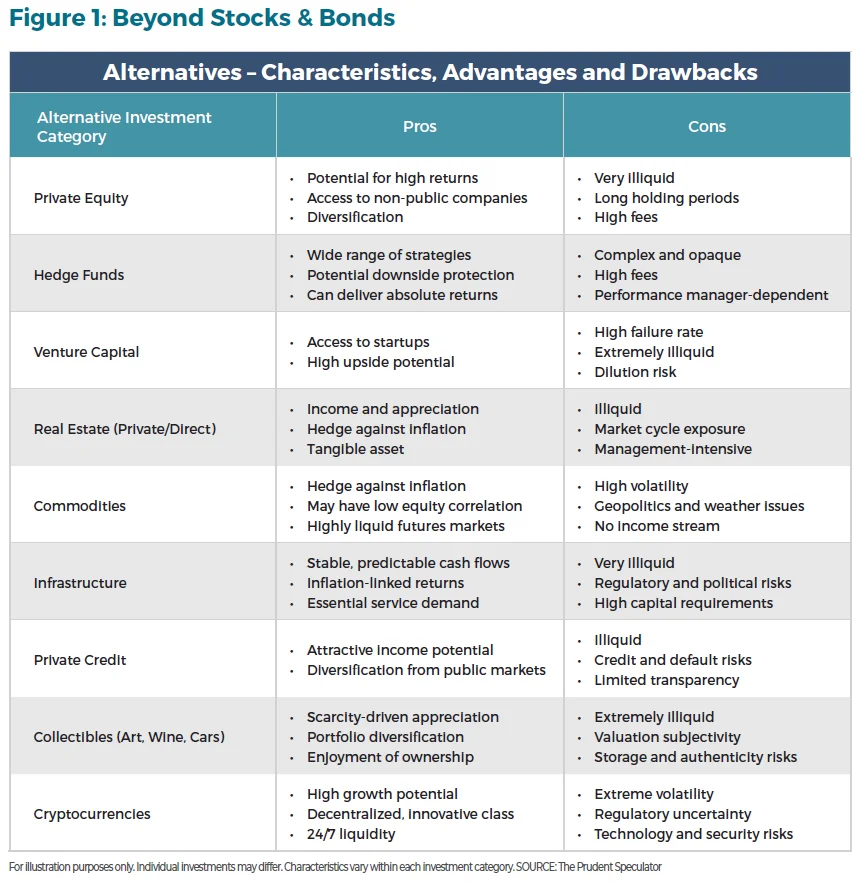
Alternatives cover a broad swath of specialized strategies. As Figure 1 (next page) shows, these vehicles are not meant to replace a foundation of stocks and bonds, but rather to serve as complementary tools. Market history reminds us that every investment option offers both promise and peril, and alternatives are no exception to that rule. Properly integrated, however, they can add useful depth to a well-constructed portfolio.
Figure 1 shows that alternative investments come in many shapes and sizes, each with distinctive characteristics that can both enhance and complicate a portfolio. Private equity, venture capital and private credit offer the promise of higher returns and diversification, but investors must contend with illiquidity, long time horizons and higher fees. Hedge funds and commodities can provide diversification, yet their complexity, volatility and dependence on manager skill or external factors cannot be overlooked. Real estate often appeals for its income and tangible nature, though the class too can suffer from illiquidity, market cycles and regulatory risks. Collectibles and cryptocurrencies round out the spectrum, offering unique opportunities for appreciation and diversification, but also carrying risks tied to subjectivity, security and extreme volatility.
Expanding an Asset Allocation
From real estate to crypto, alternative assets can diversify portfolios, generate income and hedge risks, but they demand a thoughtful approach.
REAL ASSETS
Real estate is one of the oldest and most familiar forms of investing. Whether it’s a duplex in the suburbs or a stake in a professionally managed Real Estate Investment Trust (REIT), property ownership is an investment in tangible assets that can offer cash flow, capital appreciation potential and a measure of inflation protection.
Do-it-yourself investors have several options to consider for access to this class of alternative investments. Direct ownership of rental properties provides control and tax advantages, though it also demands time, patience and tolerance for tenant issues, unit repairs and other unexpected trouble spots.
Publicly traded REITs, by contrast, offer liquidity, diversification and dividends, with common categories including residential, industrial, self-storage, data centers and health care.
Private real estate funds sit somewhere in between, providing specialized access to income-producing properties and potential appreciation, albeit with less liquidity.
Investors should keep in mind that leverage magnifies both gains and losses. Property markets are inherently cyclical, and location is critical. Finally, quality real estate management can unlock value through good maintenance, tenant selection and other strategic improvements.
INFRASTRUCTURE
Infrastructure assets are physical assets like toll roads, cellular communications towers and pipelines. These are owned for their stable, long-term cash flows and historical track record of reasonable capital appreciation.
Individual investors can access this asset in several vehicles. Publicly traded options, such as ETFs or listed partnerships, provide exposure to domestic and global infrastructure companies with the benefit of daily liquidity. While liquidity is positive, it means the share price can become disconnected from underlying asset values, so it’s particularly important to have a good estimate of value for the underlying portfolio. Real Estate Investment Trusts (REITs) sometimes hold infrastructure-related assets as well.
Private funds and interval funds give investors more specialized access to infrastructure but come with some strings attached. These vehicles usually have a set window of time to put committed money to work and can run for many years. Because they don’t show daily price swings, they may appear less volatile than they really are. In reality, investors are trading flexibility for potential reward, as the so-called illiquidity premium (extra expected return for locking up capital) means longer holding periods and limited access to cash.
Why consider infrastructure at all? Beyond the income potential, these investments often behave differently than the broader equity market, (especially during periods of inflation or rising interest rates) when their inflation-linked revenues and essential-service nature can provide a buffer. As with all alternative investments, investors should weigh the benefits of diversification and stability against the trade-offs of illiquidity, leverage risk, regulatory risk and, in many cases, higher capital requirements.
COMMODITIES, FARMS & TIMBERLAND
Real assets like farmland, timber and other property-linked investments can be attractive slices of an allocation. Their combination of income and appreciation potential is useful, plus they have historically exhibited low correlation with traditional equities, which improves diversification. Access is possible through publicly traded Real Estate Investment Trusts (REITs) or private platforms that offer fractional ownership.
Commodities (e.g. oil, gold, copper, wheat, et cetera) are unique real assets. Unlike equities or real estate, which offer earnings and cash flow, commodity prices are primarily determined by global supply and demand dynamics. Geopolitics, weather, technological shifts and production decisions can have outsized effects, too. This means that prices of commodities often behave differently than stocks or bonds.
Historically, commodities have been viewed as a hedge against inflation since prices of raw materials tend to rise when the cost of goods and services increases. Of course, commodities are volatile, so many investors prefer less-volatile vehicles, such as Treasury Inflation-Protected Securities (TIPS), for inflation protection.
For investors that wish to have commodity exposure, direct ownership is rarely practical, and most investors gain exposure through financial instruments. We generally favor diversified broad-basket ETFs, such as Invesco’s Optimum Yield fund, which provide liquid access to a mix of commodity futures. Single-commodity funds can also be attractive for targeted exposure, though they carry higher risk. Investors should note that some commodity funds issue K-1 tax forms, which may add complexity at tax time.
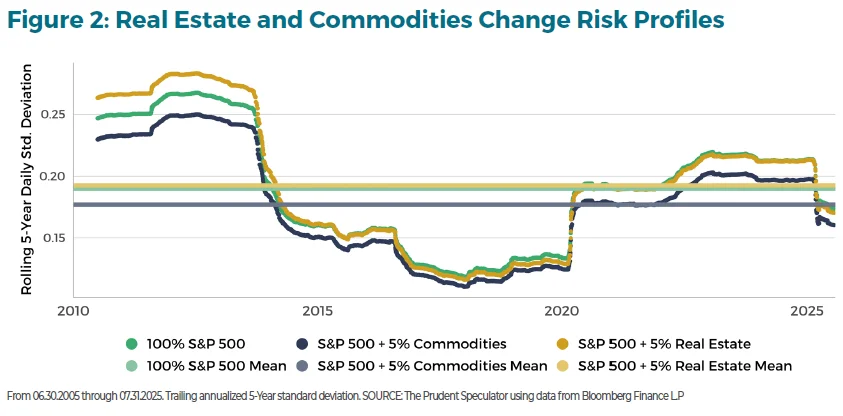
Figure 2 shows the rolling five-year standard deviation (a measure of risk) for different portfolio mixes. The green line represents a portfolio fully invested in the S&P 500. The blue line trims equity exposure to 90% and adds 10% commodities, while the yellow line trims equities to 90% and adds 10% real estate. The added commodities allocation modestly reduced average portfolio volatility, while real estate increased it slightly.
OPTIONS
Options are often thought of as the playground of short-term traders, but they can also serve the interests of patient, long-term investors. When used in certain situations, options may enhance income, provide a measure of downside protection, help with tax timing or allow one to express views without committing large amounts of capital. Like any tool, they can be misused, but in the right circumstances, they can complement an equity portfolio.
Among the more common strategies we see are covered calls, in which investors sell calls on stocks they already own. For example, if you hold 100 shares of Company A at $50, you might sell a $55 call option and collect a $5 premium. If the stock stays below $55, you keep both your shares and the cash. If the stock rallies above $55, your upside is capped at $10 per share ($5 from the stock price gain plus the $5 premium), but you’ve still locked in a solid return.
Cash-secured puts are another tool. Suppose you want to own Company B, currently trading at $40, but only if it falls to $35. By selling a $35 put, you receive a premium (say $2) today while you wait. If the stock never drops, you simply keep the income. If it does fall and the shares are “put” to you, you buy at $35, but since you collected the $2 premium, your effective cost is $33.
For those concerned about volatility, protective puts and collars can provide peace of mind. Imagine holding a stock at $60 but worrying about near-term downside. You could buy a $55 put, limiting losses below that level. To offset the cost, you might also sell a $70 call, creating a collar. You’ve traded upside for defined downside protection. Because options strategies can rapidly unravel, it’s important to make these investments with great caution. As with all investment vehicles out there, one must weigh costs, complexity and objectives.
In Figure 3, we group options strategies into two categories. Income enhancers generate cash flow. Covered calls collect premiums by forfeiting upside beyond the strike price, while cash-secured puts pay investors to wait for stocks at lower entry points, with the trade-off of having to buy if prices fall.
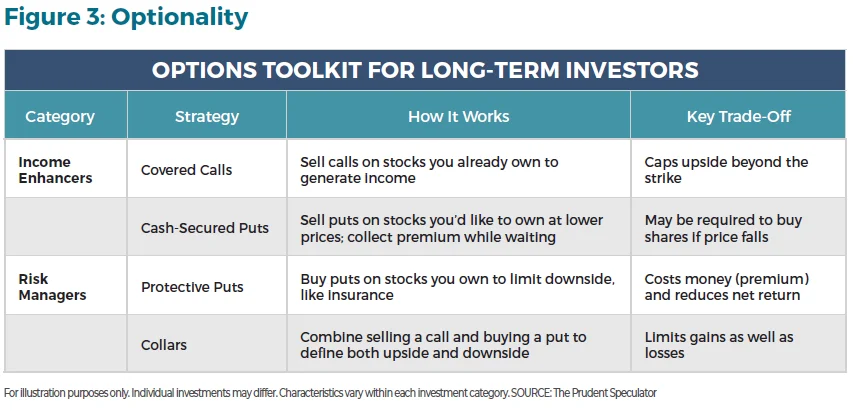
Risk managers seek to reduce volatility. Protective puts act as position insurance by limiting losses for a premium cost, and collars pair a put with a call to set both a floor and a ceiling, protecting against sharp declines but capping gains.
In general, options are expensive and ‘insuring’ a portfolio against specific outcomes can rapidly eat away at portfolio returns over longer periods of time. Therefore, the most useful options strategies are those that solve a specific problem.
DERIVATIVES & HEDGES
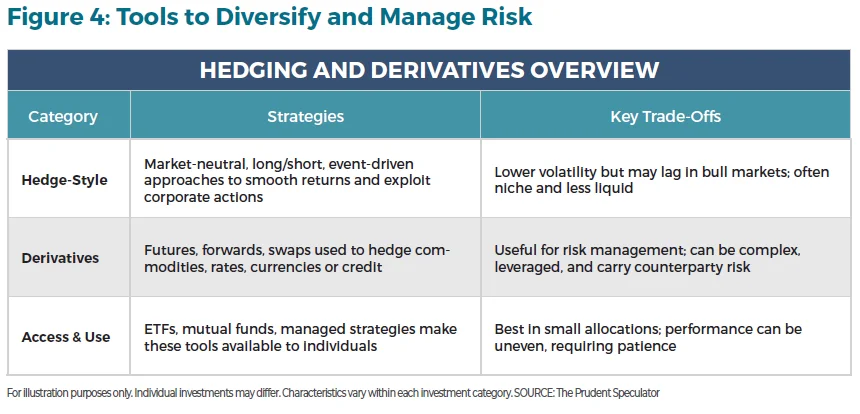
Hedge fund–like strategies once required massive minimum investments and came with hefty fees, but today many of the same approaches can be accessed through exchange-traded funds (ETFs) and mutual funds. These vehicles attempt to replicate hedge fund playbooks in a more liquid, lower-cost format, making them available to a broader range of investors.
Market-Neutral and Long/Short funds seek to reduce exposure to broad market swings by pairing long positions (bets a stock will rise) with short positions (bets it will fall). The idea is to dampen volatility and allow manager skill to shine regardless of market direction. These funds tend to be less volatile than the overall market, but they can lag during strong bull markets when simply owning stocks is the most rewarding approach.
Event-Driven strategies aim to profit from corporate actions like mergers, acquisitions, restructurings or bankruptcies. Managers attempt to exploit price discrepancies that arise during these events. Publicly available funds exist in this space, though they are often niche, capacity constrained and at times less liquid than traditional stock or bond funds.
Beyond hedge-style vehicles, derivatives play a central role in modern investing. While options are often the most familiar, investors may also encounter futures, forwards and swaps. Futures contracts are standardized agreements to buy or sell commodities, currencies or financial instruments at a set price on a future date, often employed to hedge risks like oil price spikes or interest-rate moves. Forwards are similar but privately negotiated, giving corporations and institutions more flexibility. Swaps, such as interest-rate swaps or credit-default swaps, allow two parties to exchange streams of cash flows and can be powerful tools for managing exposure to rates, credit or currencies.
For individual investors, these contracts are usually accessed indirectly through ETFs, mutual funds or managed strategies, rather than traded directly. That’s a good thing, as derivatives can be complex, highly leveraged and unforgiving when misused. Still, when employed thoughtfully and in moderation, they can provide diversification, risk management and return opportunities that complement the core stock-and-bond mix.
As with most alternatives, caution is warranted. These strategies require patience, and their return profiles can be uneven, sometimes delivering in bursts, other times lying dormant. For that reason, we believe they should occupy only a small slice of a diversified portfolio, enhancing the long-term wealth-building foundation provided by equities rather than replacing it.
PRIVATE CAPITAL ALTERNATIVE INVESTMENTS
For decades, private equity and private credit strategies were the domain of institutions and ultra-wealthy investors, fenced off by high minimums and regulatory limits. While most individual investors still cannot access the full spectrum of private markets directly in large part due to suitability restrictions, the principles behind these strategies still can help inform decisions in the public investment arena.
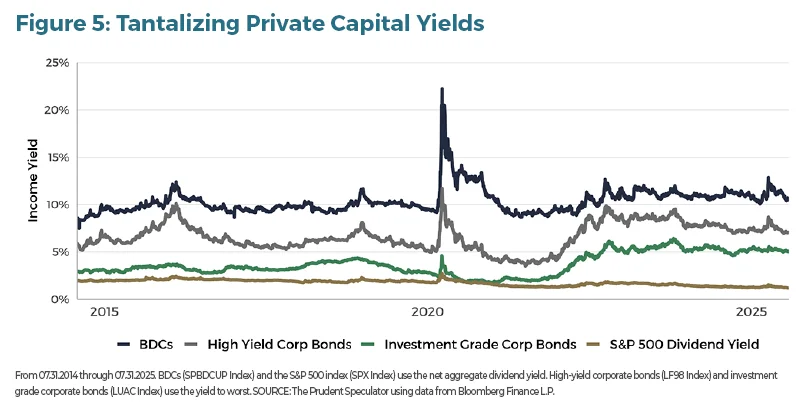
Business Development Companies (BDCs) are one example of private credit investments that lend to small and midsize private companies and provide financing when banks will not or when speed of approval is necessary. In return for the additional risk, BDCs typically pay investors attractive yields in the 7–10% range, though results vary by manager and exposure. Individual investors can use ETFs for exposure to structured credit or floating-rate loans, packaging institutional-style lending into liquid, tradable form.
BDC ETFs seek to offer a diversified set of income streams and, at times, can act as a buffer in rising-rate environments. Yet history reminds us that BDCs, and private credit strategies in general, are hardly immune to stress. During the Global Financial Crisis, many saw sharp drawdowns as defaults soared. Even in 2020’s pandemic shock, credit markets briefly froze, sending BDC prices tumbling before a rapid recovery took hold. These reminders serve to underscore both the opportunity and the risk inherent in lending-focused alternative investments.
Another area gaining attention is litigation finance (investing in the outcome of lawsuits) along with other specialty lending tied to royalties, receivables or niche assets. While these strategies have gained traction among institutions for years, individual access has only recently emerged through thematic funds and public vehicles. Their track record is shorter, but early data suggests returns can be uncorrelated with traditional markets.
As with many high-yielding alternatives, it is important to remember that there is no “free lunch.” Higher yields are often compensation for higher risks, including from illiquidity, leverage, default and others. History shows that periods of economic stress can hit private capital hard, even as strong recoveries reward patient investors. Used in moderation, private capital–like vehicles can provide useful income and diversification benefits, but they are best viewed as small slices of an overall allocation pie. Equities and bonds remain the core foundation of long-term wealth-building, a lesson borne out through cycles of boom, bust and recovery since The Prudent Speculator’s founding in 1977.
CRYPTO AND DIGITAL ASSETS ALTERNATIVE INVESTMENTS
Still in its infancy, the world of digital assets has grown rapidly over the past decade. Bitcoin, the first and most widely recognized cryptocurrency, is a decentralized store of value with a limited supply that appeals to those seeking protection against currency debasement. Ethereum and its peers go a step further, offering programmable smart contract platforms that support everything from decentralized finance to digital collectibles. Coinbase, the largest marketplace for digital assets, currently tracks more than 9,000 prices.
When Bitcoin launched in 2009, it was little more than a curiosity for cryptography enthusiasts. Trading occurred on obscure online forums, custody meant storing a private key on a personal computer and liquidity was nearly non-existent. Over time, however, Bitcoin began to expand more broadly, first as a novelty, then as a potential hedge against monetary debasement.
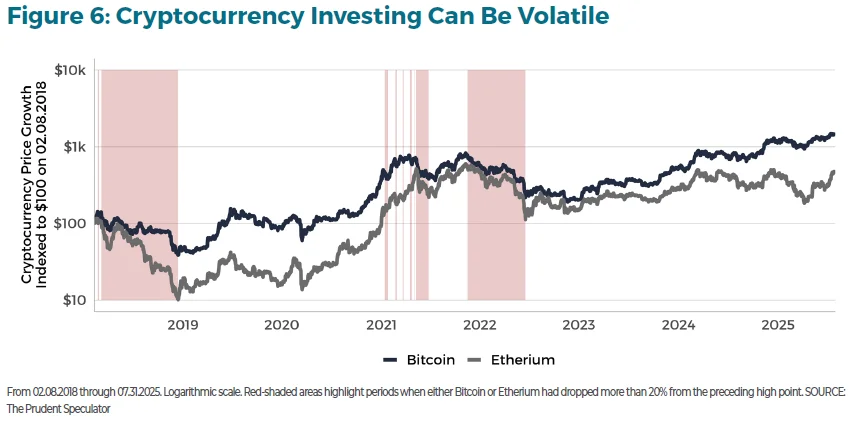
The next phase was marked by innovation beyond Bitcoin. Ethereum’s debut in 2015 introduced smart contracts which opened the door to decentralized applications, finance platforms and entire new categories of digital assets. The launch of thousands of tokens followed, but many quickly went bust. Of course, the sequence of a boom in 2017, major bust in 2018 and the rebound in subsequent years is used as a case study for those for and against crypto allocations. Figure 6 shows strong returns for those crypto investors who managed to avoid jumping ship after the value of Etherium plunged more than 91.2% to kick off 2018. Bitcoin lost value, too, but not nearly as much.
What was once a fringe activity now has mainstream access points. Institutional custodians and brokerages offer secure storage and regulated trading. Publicly listed companies may hold Bitcoin and Ethereum on their balance sheets. Exchange-traded products provide exposure without the need to manage private keys. Even retirement accounts now sometimes include cryptocurrency allocations.
We understand that many investors may wish to participate, but we urge that exposure remains small, typically no more than a modest slice of an overall allocation, and only with the full expectation of high volatility and the real possibility of losing principal. Do-it-yourself investors in particular should set strict guardrails, emphasize security and custody, and recognize that regulators have not yet caught up with the fast-moving crypto world. For now, we view digital assets as a speculative satellite holding that may offer opportunity, but not a substitute for the equities and bonds that have long proven their worth in building wealth.
ESOTERIC ALTERNATIVE INVESTMENTS
Not every investment fits neatly into categories like stocks, bonds or mainstream alternative investment options like real estate or commodities. Some corners of the market are more exotic, harder to access and less liquid, yet they attract attention for their uniqueness, emotional connection or potential diversification benefits. We group these in the group of esoteric alternatives.
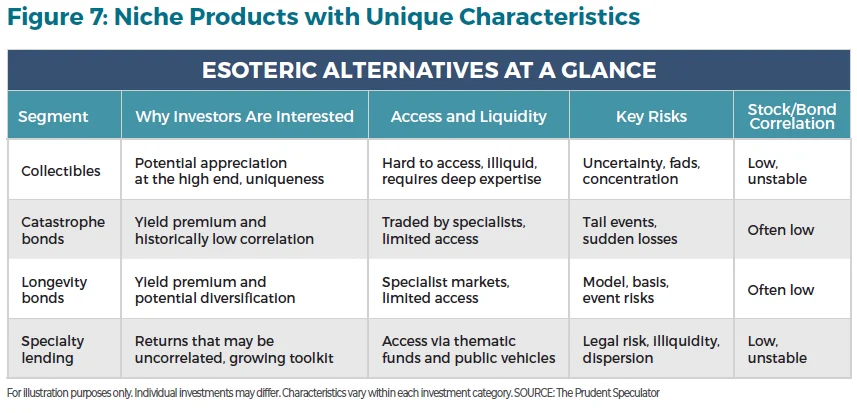
Art, wine, stamps, baseball cards, rare coins, vintage cars, luxury watches are a few, but the true list of collectible investments is long and colorful. Some of these assets have appreciated handsomely over the years, particularly at the high end of the market where scarcity is greatest. Collectibles are difficult to value, though, and are usually illiquid. They are subject to shifting tastes and fads, making them harder to value. The barriers to entry are steep, as deep expertise and connections are usually required to separate lasting value from hype. A few players may command an outside influence. In our view, collectibles are best pursued as a passion project, where the enjoyment of ownership is as important as the potential financial return, rather than as a core component of an asset allocation.
A more institutional flavor of esoteric investing involves insurance-linked securities, such as catastrophe or longevity bonds. The former allow investors to assume some of the risk that insurers face from natural disasters like hurricanes or earthquakes, in exchange for a yield premium. Longevity bonds, sometimes referred to as mortality bonds, are linked to life insurance, paying out if the group of insured persons live shorter lives than expected (and lose if those persons live longer than expected).
The appeal for both lies in their historically low correlation with traditional equity and bond markets. However, the tail risks are real: when a major event like a hurricane or pandemic strikes, losses can be large and concentrated. For that reason, insurance-linked securities are usually reserved for specialized managers and occupy only a small slice of diversified institutional portfolios.
Esoteric alternatives can diversify returns and add intrigue, but they are not substitutes for the tried-and-true wealth-building of equities and bonds. History reminds us that markets for collectibles can boom and bust with cultural fads, while catastrophe bonds can deliver years of steady income only to suffer sharp losses after a single event. For the long-term investor, these strategies may have a place (but only in moderation) with eyes wide open to the risks and with the understanding that they should complement, not replace, the foundation of a well-constructed asset allocation.
Consider the Alternatives
Complementary slices that can diversify returns, enhance income and manage risk without displacing equities as the portfolio’s cornerstone.
We have always emphasized equities as the most effective long-term wealth-building vehicle. History supports that view and we believe it will remain true in the years ahead, which is why stocks continue to be our bread and butter, while bonds and cash provide the ballast when headwinds inevitably blow again. Even so, the investment landscape has evolved, and alternative strategies once reserved for institutions are now within reach of individual investors. We view alternatives not as replacements for equities and fixed income, but as complementary slices deployed for specific purposes. Every investor will have a different use case and a different allocation, with alternatives serving roles that may include return diversification, volatility reduction, income generation or risk management.
The traditional balanced portfolio, often referred to as the “60/40”, allocates 60% to equities, 40% to fixed income. This has served investors well through market cycles, keeping equities as the growth engine while bonds cushion the blows during market downturns. As Figure 8 illustrates, such a mix remains a solid foundation, but it does not attempt to utilize the wide array of investment options currently available.
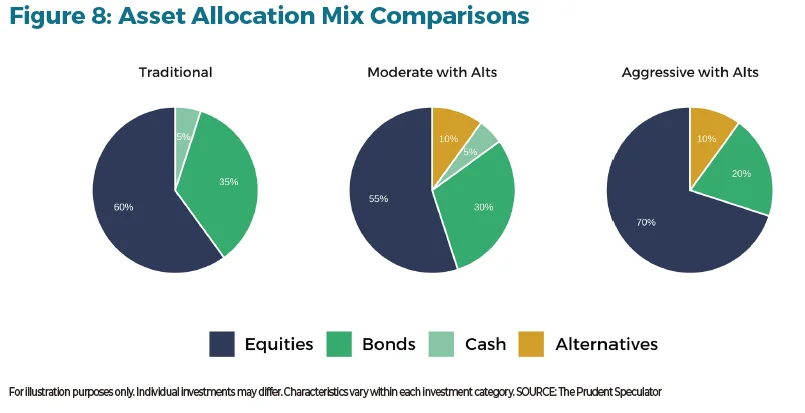
A more diversified approach, we posit, might reduce equities modestly to 55%, trim bonds to 30% and devote 10% to alternatives, while maintaining 5% in cash. The alternatives bucket could include a mix of real estate, commodities, private credit and hedging strategies, all of which offer potential for diversification and income (but consider the challenges of illiquidity, complexity and volatility). This moderate allocation, shown alongside the traditional portfolio in Figure 8, reflects our belief that modest use of alternatives can add depth without compromising the long-term wealth-building role of equities.
For those with a higher tolerance for risk, an allocation of 70% equities, 20% bonds and 10% alternatives might be appropriate. In this case, slice of alternatives tilts toward speculative categories such as digital assets, collectibles or options strategies, with the understanding that these investments carry the potential for both rapid gains and painful losses. We stress that such investments remain satellites, not core holdings, and should be kept within strict guardrails.
Market history teaches that alternatives can improve diversification, but they can also introduce new risks. Real assets and commodities, for example, often behave differently than equities, which can help smooth portfolio swings. Infrastructure and private credit may offer attractive yields, though investors must be comfortable with the trade-offs of illiquidity and default risk. Options strategies can generate income or provide downside protection, but they often lag when equity markets surge. Digital assets and collectibles may appeal for their uniqueness or potential, yet they are best approached as passion projects or small speculative slices. Beyond the allocation math, investors must weigh a number of practical realities that distinguish alternatives from traditional stocks and bonds.
CONSIDERATIONS FOR ALTERNATIVE INVESTMENTS
One important distinction with alternatives is their cost structure. Many strategies employ management fees that are higher than those of traditional funds and layer on performance fees as well. While the gross returns can be appealing, market history shows that unnecessarily elevated expenses can eat into the net result. We always keep in mind that every dollar paid in fees is a dollar that cannot compound for the investor. Those extra fees might make sense (for example, it’s a lot more expensive to buy a building than a share of common stock), or they may not.
Traditional stocks and bonds trade daily with full disclosure and regulatory oversight. Many alternatives do not. Private funds often provide limited reporting, delayed valuations and less clarity on the underlying holdings. Investors need to accept that visibility is reduced, and that trust in the manager’s valuation process is a bigger part of the equation.
Another factor often overlooked is taxation. Certain alternatives issue K-1 forms rather than standard 1099s, which can complicate or delay tax filing. Others may generate unrelated business taxable income, foreign reporting obligations or unexpected capital gain/loss distributions. Gross returns may look enticing, but the added complexity can be a turn-off.
Illiquidity is a double-edged sword. On the one hand it can protect investors from the temptation to panic sell when equity markets are in decline, effectively forcing patience through downturns. On the other hand capital tied up in illiquid structures can cause frustration when new opportunities arise but cash is locked away. Many alternatives require long lockup periods, impose penalties for early withdrawals if they are allowed at all and may be slow to return capital when redemptions are requested.
Interval funds, which promise some measure of liquidity, can create their own challenges. If too many investors head for the exits at once, managers may be forced to sell assets at inopportune times or hold excess cash in reserve rather than put it to work, both of which dilute returns for long term holders.
Even when the alternative strategy itself is performing, illiquidity can make it difficult to rebalance or to seize on opportunities when parts of the market go on sale. This rigidity is a feature, not a flaw, of many structures, but it underscores why allocation size and patience are critical.
History offers reminders. University endowments, once hailed as pioneers in the alternative investing space, have recently taken sizable haircuts on positions when liquidity needs collided with illiquid structures. Those cases are a sobering lesson that even the most sophisticated investors can be tripped up when unforeseen cash demands arise. For individual investors, the takeaway is straightforward: illiquidity may be tolerable if sized appropriately, but it is a risk that must be understood and accepted before committing any capital.
IF ALTERNATIVE INVESTMENTS ARE A FIT, WHAT’S NEXT?
Wall Street has been pushing alternatives hand over fist lately. Indeed, that can be viewed as a positive since the so-called ‘democratization’ of the investment world has opened doors to a broader set of investors. However, there are meaningful characteristics to weigh before signing up.
In our view, alternatives can be implemented effectively in moderation. They should be accents, not anchors. Equities remain the cornerstone of long-term wealth building, while bonds and cash continue to provide stability when markets turn rough. Alternatives may enrich portfolios by offering different return streams, enhanced income or targeted hedges, but they should not displace the core foundation. In practice, we see allocations in the range of 5% to 15% of a portfolio, depending on risk tolerance and liquidity needs. It is far more palatable to regret not owning more than to regret owning too much.
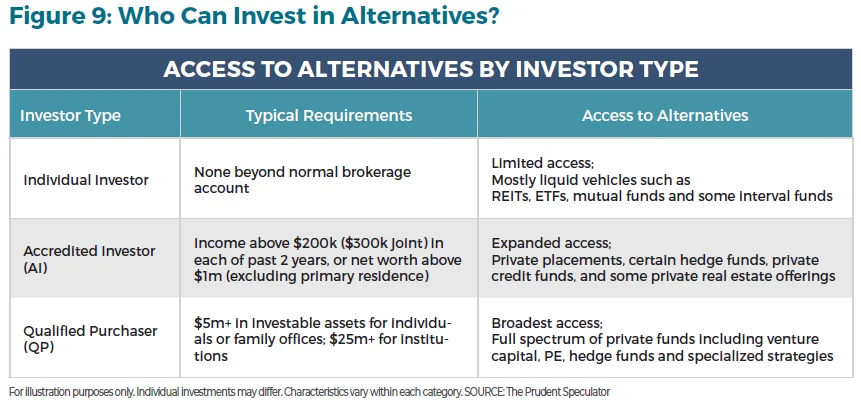
Beyond that, investors face practical hurdles. Many strategies come with high minimums and strict eligibility rules. Accredited Investor (AI) and Qualified Purchaser (QP) thresholds are meant to ensure that participants can tolerate losses, but in practice they fence out most individuals.
While the U.S. government has floated proposals to loosen access, the reality is that most funds remain the province of institutions and the wealthiest households.
Each offering has its own rules. Some accept Accredited Investors, defined as those with income above $200,000 ($300,000 for joint filers) in each of the past two years or net worth above $1 million excluding a primary residence. Others require Qualified Purchaser status, generally $5 million in investable assets for individuals or $25 million for institutions. QPs gain access to a wider menu of funds, but those funds often come with little or no disclosures and few, if any, protections for investors, which in our view raises the risk profile meaningfully.
Even for those who qualify, capital is typically held by outside managers and subject to their timing. More recently, funds have been “tickerized,” meaning they now appear on custodian statements at Schwab, Fidelity and others, offering added transparency and easier tracking of performance. Still, performance itself deserves perspective. Just because alternatives may look calmer on paper does not mean they are inherently less volatile. Pricing quarterly or annually does not eliminate risk; it simply obscures it until the next mark is taken. Illiquidity hides volatility, it does not erase it.
We see opportunities in alternatives and employ them selectively for our managed account clients when the benefits outweigh the costs. However, we remain skeptical of any claim of extraordinary annual returns with minimal risk. If equities were levered the way real estate is levered, and if we ignored the discipline of mark-to-market margin calls, they too might deliver 20% returns! The reality is that every investment involves trade-offs. Alternatives may deserve a slice of the portfolio for some investors, but they are no free lunch.
WANT TO KNOW MORE ABOUT ALTERNATIVE INVESTMENTS?
For over 48 years, our team has proudly partnered with individuals, families and business owners to navigate the complexities of long-term investing and wealth management.
Through ongoing disciplined financial planning, personalized attention and a customized approach, we have helped our clients chart paths toward their unique aspirations, no matter how intricate or challenging the journey.
To learn more about our personalized wealth and asset management services, please contact:
Jason R. Clark, CFA
Principal, Portfolio Manager
949-424-1013
jclark@kovitz.com
Please note that Figure 8 is not a recommendation to buy or sell any securities or allocate a portfolio in any manner. Alternative, options, hedge-style and derivative investments are subject to a high degree of risk and are subject to loss, including loss of principal. The list of risks in the tables are not exhaustive.